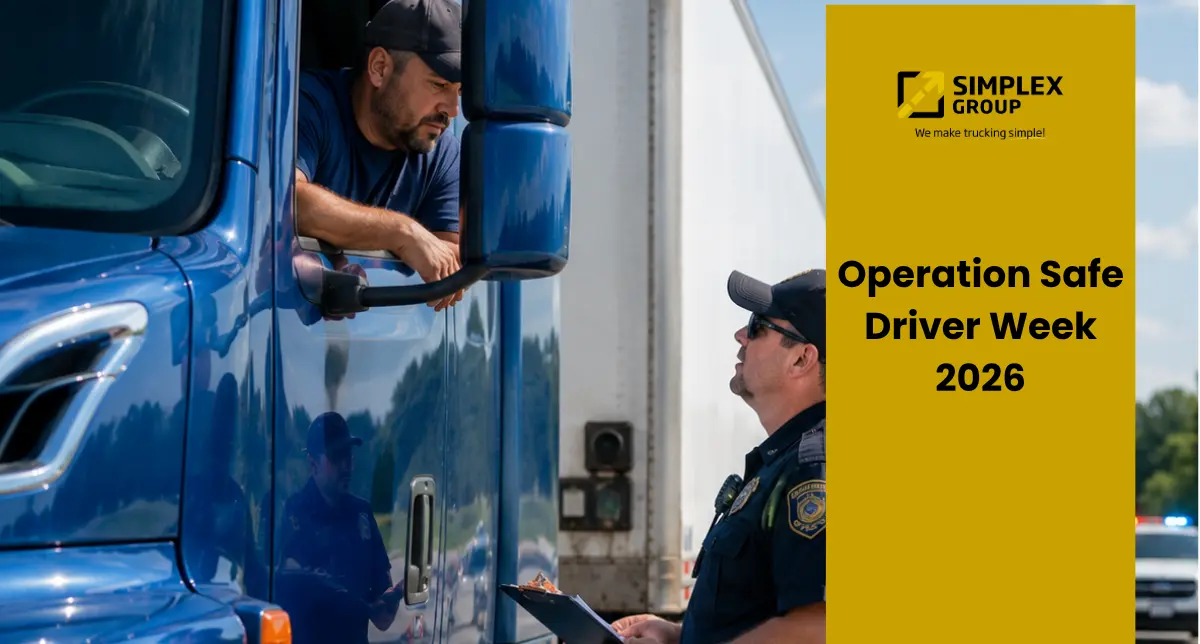
- Operation Safe Driver Week 2026 runs July 12–18, with law enforcement across the U.S., Canada, and Mexico targeting reckless, careless, and dangerous driving behaviors by both commercial and passenger vehicle drivers.
- A single citation during OSDW adds CSA points that stay on record for 24 months, affecting insurance premiums, inspection frequency, and the risk of a DOT compliance review.
- Preparation before July 12 is the most effective strategy: review driver records, verify documentation, audit ELD compliance, and brief your drivers on the 2026 enforcement priorities.
Table of Contents
Operation Safe Driver Week 2026 runs from July 12 to 18, across the United States, Canada, and Mexico. Organized by the Commercial Vehicle Safety Alliance (CVSA) in partnership with the FMCSA, this seven-day enforcement and education campaign targets unsafe driving behaviors by both commercial motor vehicle (CMV) drivers and passenger vehicle drivers. Law enforcement officers will increase patrols on major freight corridors, conduct traffic stops, and issue warnings or citations to drivers exhibiting risky behaviors on the road.
If you operate a commercial truck or manage a fleet, this week requires your attention because the consequences of a single citation extend well beyond a fine.
When Is Operation Safe Driver Week 2026?
Operation Safe Driver Week 2026 is scheduled for July 12–18, 2026. Enforcement will be active across highways and freight corridors throughout North America. Traffic stops will occur around the clock, and both CMV drivers and passenger vehicle drivers are subject to enforcement.
CVSA launched the Operation Safe Driver program in 2007. Since then, it has grown into one of the most significant annual enforcement campaigns affecting the trucking industry.
What Is CVSA’s Focus Area for 2026?
For the third consecutive year, CVSA has designated reckless, careless, or dangerous driving as the official focus area for Operation Safe Driver Week 2026.
Reckless Driving
Reckless driving is defined as operating a vehicle with willful or wanton disregard for the safety of persons or property. This includes behaviors like cutting off other vehicles intentionally, aggressive tailgating, or deliberately ignoring traffic signals. The key factor is intent; the driver knew the behavior was dangerous and did it anyway.
Careless or Dangerous Driving
Careless or dangerous driving covers situations where a driver operates a vehicle without due care, attention, or reasonable consideration for others on the road. This includes distracted driving, failure to check blind spots before lane changes, and driving while fatigued. Unlike reckless driving, careless driving does not require proof of intent.
Both categories will be actively enforced during Operation Safe Driver Week. Definitions and enforcement thresholds may vary by state or province.
What Violations Will Officers Be Looking For?
While reckless and careless driving is the 2026 focus, officers will issue citations for any unsafe driving behavior they observe during a traffic stop. Based on 2025 enforcement data, where law enforcement pulled over 8,739 vehicles and issued 2,504 citations, these are the violations that consistently appear:
| Violation | Risk Level | CSA Impact |
| Speeding | High | Unsafe Driving BASIC |
| Distracted driving/phone use | High | Unsafe Driving BASIC |
| Failure to wear a seat belt | Medium | Driver Fitness BASIC |
| Following too closely | High | Unsafe Driving BASIC |
| Impaired driving (DUI/DWI) | Critical | Unsafe Driving BASIC |
| Improper lane change | Medium | Unsafe Driving BASIC |
| Failure to obey traffic signals | Medium | Unsafe Driving BASIC |
Speeding has consistently been the most cited violation during OSDW. According to NHTSA, speeding was a factor in 29% of all U.S. traffic fatalities in 2024, with 11,288 deaths linked to speed-related crashes that year.
How a Citation During OSDW Affects Your CSA Score
A traffic stop during Operation Safe Driver Week is not just a roadside interaction. For commercial drivers, every citation issued translates directly into points added to the Compliance, Safety, Accountability (FMCSA CSA) system, and those points stay on record for 24 months.
Here’s why that matters for your operation:
- Higher CSA scores increase the likelihood of being selected for a DOT compliance review or targeted inspection
- Unsafe Driving BASIC violations (speeding, reckless driving, distracted driving) carry some of the heaviest point weights in the CSA system
- Multiple violations across your fleet can trigger an intervention from FMCSA, up to and including a safety rating downgrade
- Insurance carriers review CSA scores when setting commercial truck insurance premiums. A pattern of violations after OSDW can raise your rates at renewal
For owner-operators and small fleets especially, one citation during Safe Driver Week can create a ripple effect that lasts two years.

What Documentation Should You Have Ready?
If a law enforcement officer pulls you over during Operation Safe Driver Week, having your documentation organized and accessible makes the interaction faster and more professional. Officers expect commercial drivers to produce:
- Commercial Driver’s License (CDL) — valid and unexpired
- Medical certificate — current and matching CDL records
- Vehicle registration
- Proof of insurance — commercial trucking insurance card or documentation
- ELD records — hours of service logs for the required period
- Operating authority documents — if applicable (MC number, BOC-3 filing)
- Oversize/overweight permits — if hauling special loads
Missing or expired documentation during a traffic stop can result in additional violations beyond the initial reason for the stop. Keeping a digital and physical copy of each document in the cab eliminates this risk.
6 Steps to Prepare Your Trucking Fleet Before July 12
Preparation before July 12 is more effective than reacting after a citation is issued. These steps apply whether you run a single truck or a fleet of 50:
- Review driver records now. Pull each driver’s MVR and CSA score before the enforcement week begins. Drivers with existing violations in the Unsafe Driving BASIC are already flagged targets for increased scrutiny.
- Conduct a pre-OSDW safety briefing. Walk drivers through the 2026 focus areas, reckless and careless driving, and remind them of the specific behaviors officers will target: speed, phone use, following distance, and lane changes.
- Verify all documentation is current. Check that every driver’s CDL and medical certificate are valid. Confirm insurance documents are up to date and accessible in each vehicle.
- Audit your ELD compliance. Hours of service violations won’t be the primary target during OSDW, but they remain a secondary inspection item. Confirm ELD devices are functioning correctly and logs are complete.
- Check vehicle condition. Officers can conduct a Level I, II, or III inspection during any traffic stop. Lights, brakes, tires, and safety equipment should be in working order before the week begins.
- Slow down. Speeding is the single most common violation in every OSDW campaign. Remind drivers that arriving five minutes late is always better than a citation that affects their record for two years.
FAQs
Does Operation Safe Driver Week only affect commercial truck drivers?
No. CVSA’s enforcement during Operation Safe Driver Week targets both commercial motor vehicle (CMV) drivers and passenger vehicle drivers. However, the consequences for commercial drivers are significantly more severe, since violations feed directly into the FMCSA CSA system and can affect a carrier’s safety rating, insurance costs, and operating authority.
What should a driver do if pulled over during Operation Safe Driver Week?
Stay calm, pull over safely, and remain professional. Have your CDL, medical certificate, registration, insurance, and ELD records accessible before the officer approaches. Answer questions clearly and follow instructions. Disputing a citation on the roadside is never productive — violations can be contested through the proper legal process after the fact.
Can violations from Operation Safe Driver Week be removed from a CSA score?
Inaccurate violations can be challenged through FMCSA’s DataQ system. However, legitimate citations issued during OSDW will remain on the CSA record for 24 months from the date of the violation. This makes prevention — through driver training and proper compliance — more valuable than remediation.