
Table of Contents
A DOT compliance program is more than a binder on a shelf. In this post we’ll cover:
- Who must comply and why it matters: Typical triggers (GVWR/GCWR ≥ 10,001 lb, hazmat, passenger transport), real benefits (lower crash risk, improved CSA scores, fewer fines) and the roles of FMCSA vs. state rules.
- Core programs and what to do: HOS/ELD, Driver Qualification Files (DQF), DVIR & maintenance, Drug & Alcohol testing, cargo securement and permits — practical steps and the exact records you should keep.
- How to build and stay audit-ready: Simple file structure, essential KPIs, a 30/60/90 setup roadmap, weekly/monthly rhythms, and when to outsource to a full-service partner like Simplex Group.
What is DOT compliance and who must comply?
“DOT safety compliance” means running commercial motor vehicles (CMVs) according to the U.S. Department of Transportation rules. These rules are mainly enforced for trucking by the Federal Motor Carrier Safety Administration (FMCSA). In practice, it’s the day-to-day system that keeps your fleet legal, safe, auditable, and running without fines or shutdowns.
Who must comply?
If you run CMVs engaged in interstate commerce, you typically fall under FMCSA rules. Common triggers include:
- Vehicle GVWR/GCWR ≥ 10,001 lb.
- Transporting hazardous materials in quantities that require placards.
- Transporting passengers for compensation or large passenger vehicles.
DOT and FMCSA have different roles. DOT sets the overall policy. FMCSA creates and enforces rules for trucking. These rules include HOS, ELD, DQF, and Drug & Alcohol regulations.
States may mirror or add requirements, but your baseline comes from FMCSA.
In my daily work, I tell new owners that DOT compliance is not just a binder on a shelf. A regular part of operations exists. When I help entrepreneurs, we start with habits. After that, we work on documents. The goal is to move from “I just got my authority” to “I’m audit-ready.”
Why does it matters?
- Lower crash risk and insurance friction.
- Better CSA scores → fewer roadside headaches and more freight opportunities.
- Predictable operations: breakdowns and violations become exceptions, not the norm.
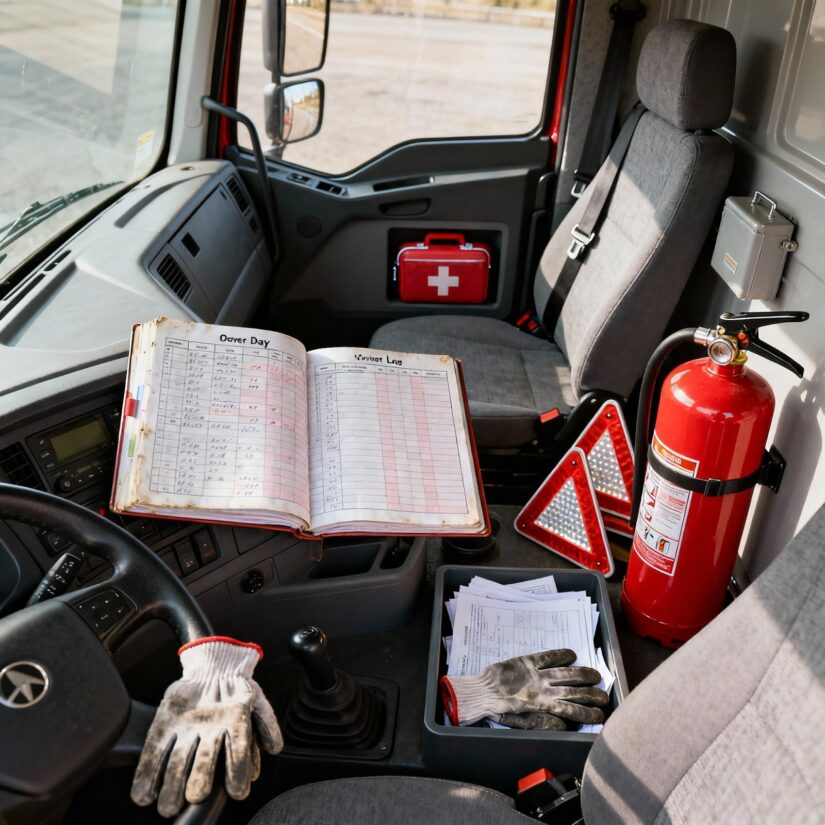
Core compliance requirements
Below I break down the “large, significant rocks.” Think of each as a mini-program with owners, workflows, and evidence.
HOS & ELD (Hours of Service and Electronic Logging Devices)
- My practice: I deploy an ELD that makes HOS intuitive for drivers. I’ve seen that when the app shows clear countdowns and easy DVIR flow, pushback drops and compliance rises.
- What to do: Make sure drivers log their duty status correctly. Use a registered ELD when needed. Check logs for edits and repeated violations. Help coach drivers.
- Tip: Schedule weekly log audits; flag patterns (e.g., “11-hour hits on Fridays”).
DVIR & Maintenance
- What to do: Pre/post-trip inspections, defect reporting, timely repairs, and a preventive maintenance (PM) calendar.
- Tip: Link PM frequencies to OEM guidance and your actual duty cycles. Use exception reports for any late PMs.
- Evidence: Keep DVIRs, repair orders, parts receipts, and PM logs together (digital if possible).
Driver Qualification File (DQF)
- What to do: Keep a complete DQF for each driver. This includes their application, MVRs, medical certificate, checks from previous employers, road test or equivalent, and training acknowledgments.
- Tip: Set renewal reminders (med card, annual MVR, license expirations) at 90/60/30-day intervals.
Drug & Alcohol Testing
- What to do: Sign up for a program that follows the rules. This program should cover pre-employment, random tests, post-accident tests, reasonable suspicion, and return-to-duty. Make sure to document everything and use the Clearinghouse correctly.
- Tip: Train supervisors on reasonable suspicion with refreshers every 24 months.
Hazmat (if applicable)
- What to do: Proper classification, packaging, marking/labeling, shipping papers, emergency response info, and hazmat-specific training.
- Tip: Build a shipment checklist to verify paperwork before a hazmat unit moves an inch.
Cargo Securement
- What to do: Follow specific rules for each commodity. Standardize tie-down counts and angles. Take photos to document good and bad practices during training.
- Tip: Quarterly “securement rodeos” (15-minute team drills) prevent nasty surprises at scales.
Licenses, Permits & Registrations
- What to do: USDOT/MC numbers (as applicable), UCR, IFTA/IRP, state permits, insurance filings, and BOC-3.
- Tip: Centralize expirations in one dashboard and assign a single owner.
Full-service support is where I’ve seen fleets breathe again. When my team takes care of permits, tax reporting, and insurance, owners can focus on winning freight. They don’t have to chase paperwork anymore
Documentation & recordkeeping for audit readiness
If it’s not documented, it didn’t happen. Build a simple structure that any auditor can navigate in minutes.
Suggested foldering (digital works best):
- Drivers/ (DQF per driver)
- Vehicles/ (titles, registrations, inspections, maintenance, DVIRs)
- HOS/ (logs, edits, coaching notes, exception approvals)
- DrugAlcohol/ (program docs, randoms, results, training)
- Hazmat/ (if applicable)
- Insurance/ (policies, endorsements, COIs, claims)
- Training/ (topics, rosters, certificates)
- Permits-Filings/ (UCR, IFTA/IRP, BOC-3, MCS-150 updates)

Document retention cheet sheet sample
| Document Set | Typical retention | Owner | Where stored |
| Driver Qualification File | Duration of employment + 3 yrs | Safety | Drivers/DQF |
| HOS logs & supporting docs | 6 months (supporting docs), logs per reg | Dispatch/Safety | HOS |
| DVIRs & maintenance records | 12 months (varies by item), plus while vehicle in service | Maintenance | Vehicles |
| Drug & Alcohol records | Varies by test type (1–5 yrs typical ranges) | Safety | DrugAlcohol |
| Training rosters & certs | 3 yrs (or per topic) | Safety | Training |
| IFTA/IRP, UCR filings | 4 yrs (common tax doc practice) | Compliance/Admin | Permits-Filings |
I routinely take over the “paper chase.” My rule: everything has an owner, a renewal date, and a home. Our dashboard, Simplex Hub, and mobile app, Simplex 2GO, provide drivers and admins with the same information. No more “it’s on Bob’s desktop.”
How to build your compliance program step by step (new carriers & growing fleets)
Step 1 — Foundation (authority & insurance)
- USDOT/MC (as applicable), BOC-3, insurance filings, UCR, IFTA/IRP.
- Draft your Safety Policy: HOS, DVIR, D&A, accident reporting, mobile device use.
- Select your ELD and inspection tools; define roles (who audits what, when).
Step 2 — People & vehicles
- Build DQFs for each driver; run background/MVR checks; onboard with documented training.
- VIN-level vehicle files; baseline inspections; PM schedule; parts vendor list.
Step 3 — Daily rhythm
- Dispatch pre-checks (driver & unit), HOS monitoring, DVIR close-out, maintenance tickets.
- Weekly compliance review: log violations, DVIR defects, PM past due, training gaps.
Step 4 — Monthly & quarterly
- CSA/SMS score review, Corrective Action Plans, random testing selections, IFTA reporting.
- Internal mock audits (desk review + sample roadside inspections).
When founders feel overwhelmed, which is normal, I help with a complete setup. My experts open the company, manage the paperwork, and set up the workflows. This way, you can focus on running the business, not the binders.
Continuous monitoring: metrics, alerts, and lowering your CSA scores
What gets measured gets improved?. Track these five:
- HOS violation rate (by driver, by lane)
- DVIR defect close-out time (open → repaired)
- PM on-time percentage (units current vs. total)
- Inspection results (violations per inspection; trends by location)
- Accident/incident frequency (per million miles)
How to act on the data?:
- Create driver scorecards tied to coaching—not punishment.
- Run root-cause on recurring violations (e.g., tight appointment windows causing HOS pressure).
- Celebrate zero-violation inspections publicly—it works wonders.
I centralize these KPIs in a single dashboard. With Simplex Hub, my alerts hit 30/7/3 days before renewals; with our Simplex 2GO app, drivers submit DVIR photos that flow straight to maintenance. That’s how we keep the “paper cuts” from bleeding cash.
Common mistakes and how to avoid them
- Treating compliance as a project, not a process. Fix: assign owners and cadences.
- Buying an ELD and calling it a day. Fix: weekly log reviews and coaching.
- Letting DQF renewals creep up. Fix: 90/60/30-day reminders and monthly file audits.
- Reactive maintenance. Fix: PM schedule + exception reporting; DVIRs must close the loop.
- Ignoring training refreshers. Fix: short, topic-based micro-sessions quarterly.
- For hazmat fleets: paperwork gaps—even one missing emergency response doc can ruin a day. Use pre-dispatch checklists religiously.
After 20+ years helping trucking entrepreneurs grow, my mantra is simple: “fewer surprises.” We take care of the boring tasks for you. This includes permits, tax reporting, and insurance paperwork. This way, you can focus on what you do best: keeping freight moving.
30/60/90-day roadmap (new carriers)
Days 1–30: Build the base
- Authority, insurance, filings, UCR, IFTA/IRP live.
- Safety Policy issued; ELD & DVIR workflows trained.
- DQFs complete; PM schedule loaded for every unit.
Days 31–60: Prove the rhythm
- Weekly HOS audits; fix top 3 violation patterns.
- First internal mock audit (sample 3 drivers, 3 units).
- Random testing cycle started; training gaps closed.
Days 61–90: Optimize
- Driver scorecards; coaching plans documented.
- CSA trend review; corrective actions implemented.
- Quarterly maintenance and safety review cadence formalized.
DOT safety compliance isn’t about memorizing regulations—it’s about building a simple, repeatable operating system that keeps your people safe and your business profitable. With the right checklists, a clean file structure, and real-time dashboards, you’ll be inspection-ready any day of the week. If you’re just getting started—or you’re scaling fast and buried in admin—lean on a full-service partner. I’ve helped owners set up everything from permits and tax reporting to insurance and ELDs, so they can “see road ahead” instead of watching the inbox.
Feel free to contact our team of experts and learn more about our DOT compliance company.
FAQs
Is an ELD always required?
Not always—there are exemptions. But if you need to use one, you must ensure it appears on the FMCSA’s registered list and configure it correctly (modes, edits, data transfer).
What belongs in a DQF?
Application, MVRs, prior employer checks, medical certificate, road test or equivalent, training/acknowledgments, and ongoing updates (annual MVR, med renewals).
How do I prep for a New Entrant audit?
Have evidence for each program (HOS, DQF, D&A, maintenance, insurance). Practice a desk review: can a stranger find what they ask for in under two minutes?
How do I improve CSA scores?
Target the categories where you have the most violations (often HOS and Vehicle Maintenance). Coach drivers, fix vehicles, and document corrective actions.
What services can a full-service partner cover?
From authority setup to UCR, IFTA/IRP, insurance filings, ELD rollout, DQFs, drug & alcohol, training, and ongoing audits. That “one-stop” model is how I keep owners focused on growth—not paperwork.