
Table of Contents
The transportation of cargo from origin to destination entails a significant responsibility to deliver goods safely and intact. However, encountering damaged cargo is not uncommon. Hence why understanding the critical role of documenting such incidents is so important, with this latest article both emphasizing the importance of taking pictures of damaged cargo and outlining the best practices for drivers.
The Significance of Documenting Damage:
Evidence of damage, such as photographs, offer undeniable visual proof of the cargo’s condition at the time of discovery, establishing a clear record of the damage. This, in turn, facilitates client communication, as sharing detailed images with the clients helps them grasp the extent of the damage, aiding in their decision-making and the claims process. Furthermore, timely and clear photographic evidence is invaluable in insurance claims, as it often speeds up and streamlines the process and mitigates financial impacts.
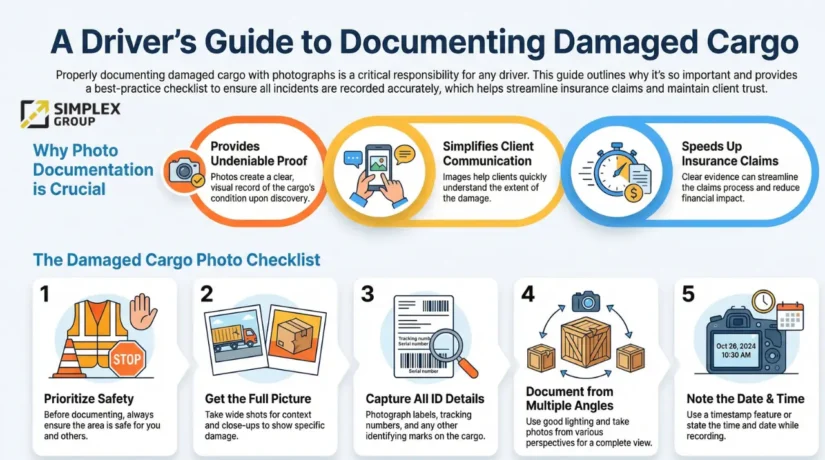
Best Practices for Documenting Damaged Cargo:
As always, make sure to prioritize your personal safety and that of others when approaching damaged cargo.
- Capture Detailed Close-Ups: Capturing close-up shots of specific damaged areas highlights the nature and extent of damage.
- Capture Overall Context: Including wider shots provides a complete view of the cargo and its surroundings.
- Document Packaging and Surroundings: Documenting the condition of packaging or containers helps you assess if they contributed to the damage.
- Label and Mark Documentation: Photographing any relevant labels or identification tags can help provide additional information about the cargo.
- Capture Cargo Identification: Ensuring that photos include the cargo’s identifying details like tracking numbers or descriptions is critical.
- Capture Quantitative Evidence: If the damage affects the quantity, it is important to document this clearly with photographs.
- Take Note of Date and Time (Accurately): Using a date and time stamp or verbally stating these details while taking pictures ensures chronological accuracy.
- Capture Multiple Perspectives: Photographing the damage from various angles offers a comprehensive view.
- Ensure Optimal Lighting: Capturing good lighting conditions helps accurately capture the extent of the damage.
Documenting damaged cargo is a vital part of a driver’s role.
Neglecting this responsibility can not only significantly affect your ability to address and resolve issues, but also impact client satisfaction, and, therefore, your company’s reputation.
By adhering to these guidelines, you help ensure transparency and trust in our operations.
Hence why we consider this guide to be of the upmost importance.
For any questions or further guidance on documenting damaged cargo, our safety and compliance department is ready to assist you.
Do not hesitate to call us!
Cargo Damaged Report Template
We created a comprehensive Cargo Damage Report Template in professional document format (PDF). This template includes:
- Shipment Identification – B/L numbers, dates, booking details
- Party Information – Shipper, consignee, and reporting party contact details
- Shipment Details – Origin, destination, carrier, transport mode, weight
- Cargo Description – Item details and original invoice value
- Damage Type Classification – 8 damage categories (water, physical, contamination, temperature, theft, handling, accident, other)
- Detailed Damage Assessment – Extent, severity levels (minor/moderate/major/catastrophic), root cause analysis
- Financial Impact – Repair vs. replacement costs, salvage values, total claim amount
- Supporting Documentation – Checklist for required attachments (photos, inspection reports, invoices)
- Carrier Information – Responsible carrier details and inspection notes
- Claim Information – Insurance policy and liability details
- Authorization & Signatures – Sign-off by preparer and approver
- Additional Notes – Space for comments
FAQs
What photos actually help a claim?
Wide shots of the trailer and load, close-ups of damage and labels/SKU, pallet counts, seal/tag, trailer plate, BOL/PRO, and any leaking/debris—time-stamped if possible.
Can I throw away damaged product?
No. Hold freight for inspection/salvage until the carrier/shipper/insurer instructs you in writing