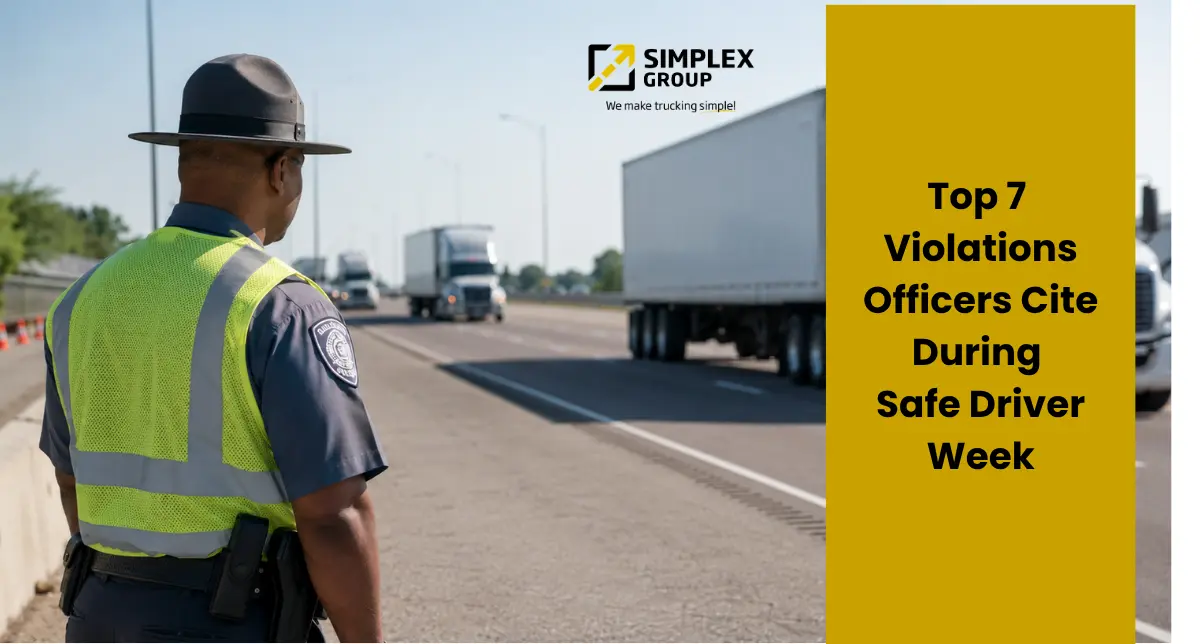
- Operation Safe Driver Week 2026 (July 12–18) focuses on reckless, careless, and dangerous driving, but officers will also cite speeding, distracted driving, seat belt, and following-too-closely violations.
- Citations issued during enforcement week feed directly into the FMCSA SMS and stay on your carrier record for 24 months, affecting CSA scores, insurance rates, and shipper contracts.
- Preparation is the right approach: review driver records, reinforce HOS compliance, and verify seat belt and phone policies before the enforcement window opens.
Table of Contents
Operation Safe Driver Week runs July 12 through 18, 2026, and law enforcement officers across North America will be out specifically looking for unsafe driving behavior in both commercial and passenger vehicles. For trucking fleets, this is not a week to wing it.
CVSA has confirmed that the 2026 focus area is reckless, careless, or dangerous driving; a broad category that covers everything from aggressive lane changes to operating with willful disregard for road safety. But enforcement activity will not stop there. Officers will also be targeting the same core violations that appear in roadside data year after year.
Here are the seven violations they prioritize most, and what your drivers need to know before hitting the road this week.
1. Speeding
Speeding is the single most common unsafe driving behavior cited during Operation Safe Driver Week, and it is not hard to see why. Speeding has been a factor in more than a quarter of U.S. crash deaths every year since 2008. In 2024 alone, speed-related crashes accounted for 29 percent of all roadway fatalities nationwide.
For CDL holders, a speeding citation is not just a fine; it follows the driver’s PSP record for up to three years and adds points to the carrier’s CSA Unsafe Driving BASIC. A violation of 15 mph or more over the posted limit is classified as a “serious traffic violation” under federal regulations, meaning two convictions within three years can result in a 60-day CDL disqualification.
Officers during Safe Driver Week will be targeting high-speed corridors, freight routes, and highway segments known for commercial vehicle speed violations.
2. Distracted Driving
Federal regulations prohibit CMV drivers from holding or using a handheld mobile device while operating a commercial vehicle (CFR 392.82). Texting while driving carries its own prohibition and penalty structure (CFR 392.80). During Safe Driver Week, officers will be actively looking for drivers with phones in hand, and the fines for violations are among the most severe in commercial transportation.
A first offense for texting while driving a CMV can result in civil penalties of up to $2,750 for the driver and up to $11,000 for the employer if the company knew or should have known about the practice. Repeat violations can lead to driver disqualification.
3. Failure to Wear a Seat Belt
Seat belt violations are low-effort for officers to cite and high-impact for drivers. In 2024, nearly half of the 22,713 passenger vehicle occupants killed in crashes were not wearing seat belts. For CMV drivers, federal law under CFR 392.16 requires seat belt use at all times.
A seat belt violation during Safe Driver Week adds points to the carrier’s CSA score and generates a citation that becomes part of the driver’s record. Fleets that verify seat belt compliance through dashcam systems and pre-trip reminders tend to see far fewer citations during enforcement events.
4. Following Too Closely
Commercial vehicles require significantly more stopping distance than passenger cars. At highway speeds, a fully loaded 80,000-pound truck traveling at 65 mph needs 525 feet or more to stop, nearly the length of two football fields. Following too closely (CFR 392.2FC) dramatically increases rear-end collision risk, one of the most expensive and frequently cited crash types involving commercial vehicles.
During Safe Driver Week, officers on highways and interstates will be watching for gaps between vehicles. Drivers should use the three-second rule as a minimum following distance under normal conditions, and extend that buffer in heavy traffic, wet roads, or any situation with reduced visibility.
5. Reckless, Careless, or Dangerous Driving
This is the 2026 focus area for Operation Safe Driver Week. Reckless driving, operating a vehicle with willful or wanton disregard for the safety of others, is treated as one of the most serious violations in the FMCSA’s CSA system. FMCSA classifies it as a red-flag indicator of potential crash involvement.
Behaviors that can be cited under this category include aggressive lane changes, cutting off other vehicles, excessive speed through construction zones, and unsafe passing maneuvers. Carriers with a pattern of reckless driving violations face increased DOT inspections, higher insurance premiums, and a sharp drop in their ability to win contracts with safety-conscious shippers.
6. Improper Lane Changes and Failure to Yield
Intersection violations and improper lane changes fall under CFR 392.2 and carry moderate-to-high severity weights in the SMS. Running a stop sign, failing to yield at a merge, or changing lanes without signaling are not considered minor infractions for commercial drivers; they indicate inattentive or aggressive driving and are consistently linked to high-severity crash types.
Officers during Safe Driver Week will be particularly attentive to these behaviors at high-traffic intersections and on-ramps where commercial vehicles interact with passenger traffic. Remind drivers that their visibility obligations are different from standard passenger vehicle drivers; blind spots, turning radius, and crossing time all require an extra margin.
7. Operating While Fatigued or Impaired
Driving while fatigued or impaired by illness is prohibited under CFR 392.3. Driver fatigue remains one of the top causes of CMV-related crashes in the U.S., and it is among the most difficult behaviors for drivers to self-assess. Officers who observe erratic driving, drifting, or delayed reactions during Safe Driver Week may pull a driver over for a fatigue evaluation.
Carriers should reinforce Hours-of-Service compliance in the days leading up to July 12. Drivers who are operating close to their limits should not be pushed for extra miles during a known enforcement week. The compliance value of keeping drivers fresh far outweighs the marginal freight revenue of squeezing additional hours.
How Violations During Safe Driver Week Affect Your Operation

Citations issued during Safe Driver Week are not temporary enforcement records; they feed directly into the FMCSA’s Safety Measurement System and remain on your carrier’s profile for 24 months. A cluster of violations during a single enforcement week can push your Unsafe Driving BASIC above intervention thresholds and trigger follow-up scrutiny from the FMCSA.
The downstream effects compound: insurance carriers pull SMS data at renewal, and a spike in violations during a high-visibility enforcement period is precisely the kind of pattern that underwriters flag when setting premiums. Shippers who monitor CSA scores will notice the movement, too.
Simplex Group’s DOT compliance team works with trucking entrepreneurs nationwide to build driver qualification programs, maintain accurate records, and manage the compliance filing requirements that keep carriers in good standing year-round. Our Simplex Hub platform gives fleet managers visibility into compliance status in real time, so enforcement events like Safe Driver Week never come as a surprise.
Frequently Asked Questions
Does a citation during Safe Driver Week count differently than a regular roadside citation?
No. Citations issued during Operation Safe Driver Week carry the same weight in the FMCSA SMS as any other roadside citation. The difference is the volume — enforcement intensity is higher during the week, which means the statistical risk of receiving a citation is greater for any commercial vehicle on the road.
Can a driver contest a citation received during Safe Driver Week?
Yes. Drivers can contest citations in the local jurisdiction where the violation was issued, and carriers can challenge data through the FMCSA DataQs process if they believe a violation was recorded incorrectly. Carriers who successfully challenge and win a correction can have the associated CSA points removed. Filing promptly and with thorough documentation produces the best outcomes.
What should a driver do if pulled over during Safe Driver Week?
Drivers should remain calm and cooperative, have all documentation ready — CDL, medical certificate, registration, and any ELD logs — and avoid arguing with the officer at the roadside. Contesting a citation, if warranted, should happen through proper legal channels after the stop, not during the interaction.