- Starting a trucking company requires more than buying a truck. You need the right business model, legal setup, authority, insurance, and safety controls before hauling your first load.
- For-hire interstate carriers typically need a USDOT number, and many also need operating authority, a BOC-3 filing, insurance on file, and UCR registration before operating legally.
- The carriers that launch more smoothly usually treat compliance, permitting, cash flow, and risk management as part of the business plan, not as paperwork to fix later.
Table of Contents
Starting a trucking company in the United States means building a transportation business that is operationally ready, financially realistic, and compliant from day one. The opportunity is real, but so is the complexity. New carriers must think beyond equipment and freight and make sure their business structure, authority, insurance, safety controls, and reporting obligations are aligned before the first load moves. FMCSA’s registration process, operating authority rules, and New Entrant requirements make that clear.
That is where many startups get stuck. They know they want independence, better margins, and long-term growth, but they underestimate how closely compliance, permitting, insurance, and cash flow work together.
After more than 25 years supporting trucking entrepreneurs nationwide, Simplex Group has seen that the strongest launches happen when operators build the business in the right sequence and choose support that matches how they actually run their fleet.
What it really takes to start a trucking company
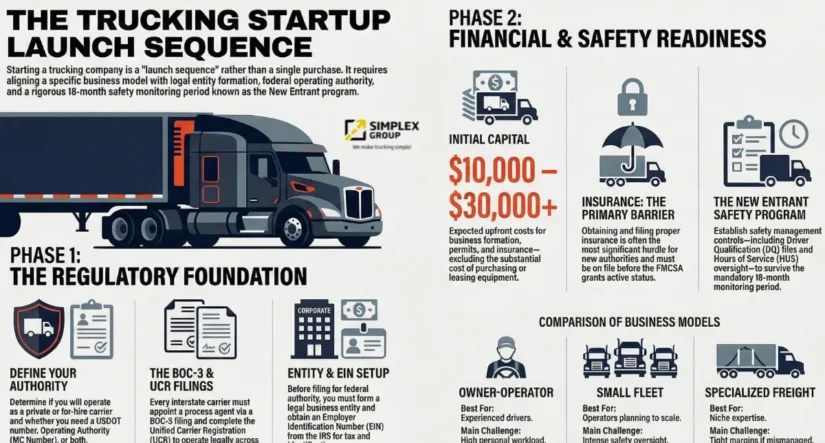
To start a trucking company, you need five things working together: a clear business model, a legal business entity, the right FMCSA registrations, proper insurance, and a safety/compliance system that can survive the New Entrant period. FMCSA states that new interstate carriers must determine registration needs, complete the application process, meet insurance requirements, handle state notifications where required, and begin the New Entrant Safety Assurance Program.
This is why starting a trucking company is not just a “buy a truck and find a load” decision. It is a launch sequence.
Before filing anything, answer these questions:
- Will you operate as an owner-operator or build a fleet?
- Will you haul general freight or specialize in a niche?
- Will you operate intrastate, interstate, or both?
- Will you be a private carrier or a for-hire carrier?
- Will you manage compliance internally or with outside support?
For many new entrepreneurs, the best first move is not expansion. It is clarity. A single-truck operation with a strong compliance foundation is often a better launch than a rushed fleet setup with weak controls.
Choose your business model before you file anything
The best trucking business model depends on your capital, operational experience, risk tolerance, and target freight. There is no single “most profitable” trucking business for everyone. Specialized niches can command stronger margins, but they also bring higher equipment, training, insurance, and compliance demands.
General freight may be easier to enter, but it can be more competitive. Industry sources commonly point to specialized segments such as hazmat, tanker, or car hauling as higher-paying niches, while broader guidance on profitability emphasizes margin control and cost discipline rather than a universal winner.
Here is a simple comparison:
| Model | Best for | Main advantage | Main challenge |
| Owner-operator | Experienced drivers starting lean | Lower overhead and faster launch | Limited redundancy and high personal workload |
| Small fleet | Operators planning to scale | More revenue capacity | More management, hiring, safety oversight |
| Specialized freight | Carriers with niche expertise | Higher rate potential | More risk, more requirements, tighter margins if mismanaged |
This is also where business planning matters. SBA guidance used in competitor content is correct on the fundamentals: define services, market, structure, funding needs, and financial projections before launch.
At Simplex Group, this is usually the point where new carriers realize they do not just need paperwork. They need a launch plan that matches how they want to operate. Some want self-service tools through a centralized hub. Others want on-demand support. Others need full-scale management with a dedicated account manager because they want to stay focused on operations while experts handle the back office.
Build the legal and regulatory foundation correctly
Most new carriers should start by forming the business entity, obtaining an EIN, and then determining which FMCSA registrations apply. The IRS states that an EIN can be obtained directly from the IRS online for free, often immediately after approval. FMCSA states that carriers must determine whether they need a USDOT number, operating authority, or both. For-hire interstate carriers transporting regulated property generally need operating authority in addition to a USDOT number.
A practical launch sequence looks like this:
- Form your business entity
- Apply for your EIN
- Determine whether you need a USDOT number only or a USDOT number plus operating authority
- File for authority through FMCSA
- Make sure insurance is filed correctly
- Have the BOC-3 filing completed by a process agent
- Register for UCR if required
- Prepare for New Entrant monitoring and your safety audit window
A few points matter here:
- USDOT number identifies your company for safety monitoring and compliance.
- Operating authority / MC number determines the type of for-hire operation you may run and the cargo you may carry.
- BOC-3 must be filed by a process agent on behalf of the applicant carrier.
- UCR is a separate registration that many interstate carriers must complete, and 2026 fees are currently listed by bracket, starting at $46 for 0-2 vehicles.
- New Entrant status generally applies for 18 months and includes safety monitoring requirements.
Prepare your insurance, equipment, and startup budget
Startup costs vary, but new carriers should expect meaningful upfront expenses before revenue becomes predictable. Recent industry guides estimate typical upfront startup costs in the $10,000 to $30,000+ range before truck and trailer costs are fully considered, while truck purchase or lease costs can add substantially more depending on equipment strategy. Even competitor content aimed at beginners places startup expectations in a similar band.
A more useful way to think about cost is by category:
| Cost area | What to expect |
| Business formation | State filing and administrative setup |
| EIN and registration | Federal IDs and registration filings |
| Authority and permits | FMCSA authority, BOC-3, UCR, and other applicable registrations |
| Insurance | Often one of the biggest barriers for new authorities |
| Equipment | Down payment, lease, or full purchase |
| Operating capital | Fuel, maintenance, payroll, tolls, repairs, cash reserve |
Simplex Group’s experience aligns with that reality. Compliance, permitting, and tax reporting cannot be treated as separate from freight planning, factoring, or insurance. They all affect whether a new carrier can keep moving without preventable interruptions. The goal is not just to launch. It is to stay operational.
Set up your safety and compliance systems before your first load
A trucking company should set up its compliance systems before hauling its first load because FMCSA’s New Entrant framework is not just about registration. It is about whether the carrier has safety management controls in place during its first 18 months.
That means your startup checklist should include:
- Driver qualification file management
- Hours of Service oversight
- CSA monitoring
- Vehicle inspection and maintenance controls
- Recordkeeping processes
- Audit readiness
- Clear responsibility for ongoing filings and updates
This is where many operators discover that getting authority was the easy part. Keeping the company compliant is the real operating discipline.
At Simplex Group, every carrier is not treated the same because every carrier does not operate the same way. That is why the Compliance Suite is built in three levels of support. Some carriers prefer a self-service model through the Simplex Hub. Others want on-demand support through the Essentials Program.
Others need a Managed Program with a Dedicated Account Manager. The practical value is straightforward: fleets can choose a level of oversight that fits their actual workflow while reducing risk and improving safety performance.
That support becomes especially useful when carriers need help with DQ file management, CSA tracking, mock audits, and HOS management. Those are not decorative compliance services. They are part of staying on the road safely and confidently.
Grow with the right support structure and back-office processes
A trucking company becomes easier to scale when the owner stops treating back-office work as an afterthought. Growth depends on more than freight volume. It depends on whether the company can support more complexity without losing control of compliance, cash flow, and risk.
That is one reason a compliance-first launch is so important. If your reporting, filings, insurance coordination, driver files, and safety systems are weak at one truck, they usually break harder at three or five.
The best early growth strategy is usually this:
- Build a clean legal and regulatory foundation
- Protect cash flow
- Standardize safety processes
- Add support before complexity forces a crisis
- Expand only when the business can absorb more equipment, drivers, and compliance responsibility
For independent and ambitious entrepreneurs, that structure matters. Many enter trucking to create a better life for themselves and their families. That goal is absolutely realistic, but it works best when the business is built with the same seriousness as the driving operation itself.
FAQs
Do you need a CDL to start a trucking company?
If you will personally operate a commercial motor vehicle that requires a CDL, then yes. FMCSA states that interstate commercial drivers must meet CDL requirements, and interstate operation generally requires drivers to be at least 21 years old.
Do all trucking companies need an MC number?
No. Some carriers need only a USDOT number, while many for-hire interstate carriers also need operating authority. The answer depends on how the company operates and what it transports.
What is the biggest mistake new carriers make?
One of the biggest mistakes is launching with authority but without a real compliance system, enough working capital, or a clear insurance and safety plan. The regulatory side and the cash-flow side must be built together.