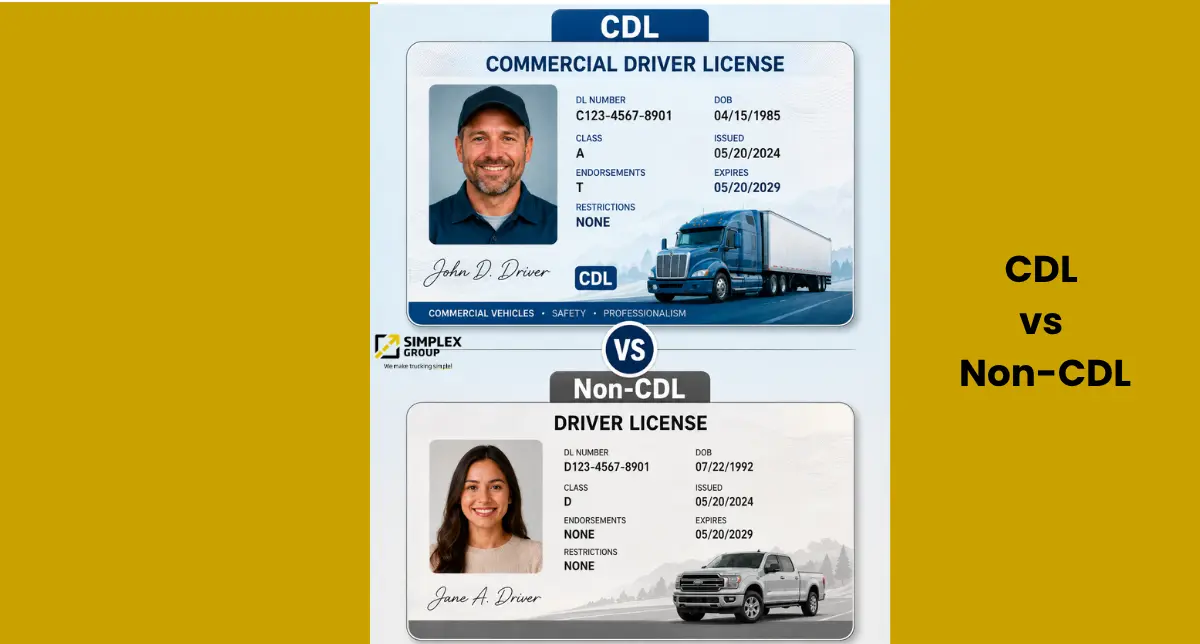
- The difference between CDL vs non-CDL is not just a licensing issue; it affects vehicle classification, driver qualification files, insurance, audits, safety performance, and scalability.
- A CDL is generally required when vehicle weight, combination weight, passenger capacity, or hazardous materials rules trigger federal CDL thresholds.
- A non-CDL operation can still have DOT compliance obligations, including vehicle maintenance records, insurance, permits, driver files, medical cards, HOS rules, and safety oversight, depending on the operation.
Table of Contents
Understanding the difference between CDL and non-CDL drivers is not just a licensing question. For motor carriers, owner-operators, fleet managers, and trucking entrepreneurs, it is a compliance decision that can affect vehicle classification, driver qualification files, insurance exposure, safety performance, audits, and long-term scalability.
In the United States, a Commercial Driver’s License, commonly known as a CDL, is required to operate certain types of commercial motor vehicles. A non-CDL driver, on the other hand, may still operate commercially in some cases, but only when the vehicle, cargo, passenger capacity, and operation do not trigger CDL requirements.
After more than 25 years supporting trucking entrepreneurs nationwide, we have seen that the biggest mistake is assuming that “non-CDL” means “no compliance.” That is rarely the case. The better question is: What does your operation require based on vehicle weight, freight type, passenger use, state rules, and FMCSA regulations?
FMCSA states that operating a Commercial Motor Vehicle requires a higher level of knowledge, experience, skills, and physical ability than operating a non-commercial vehicle, and CDL applicants must pass knowledge and skills testing for those standards
CDL vs Non-CDL: The Quick Answer
A CDL is generally required when a driver operates a vehicle or a combination of vehicles that meets federal CDL thresholds. This often includes heavier trucks, tractor-trailers, certain buses, passenger vehicles, and vehicles transporting hazardous materials requiring placards.
A non-CDL license may be enough when the vehicle does not meet CDL weight, passenger, or hazardous materials requirements. However, a non-CDL commercial operation may still be subject to DOT number requirements, driver qualification rules, vehicle maintenance obligations, insurance requirements, hours-of-service rules, and safety oversight, depending on the operation.
FMCSA guidance explains that a combination vehicle with a GCWR under 26,001 pounds does not require a CDL unless it transports hazardous materials as defined by regulation or is designed to transport 16 or more people, including the driver.
For a trucking business, this distinction matters because the wrong classification can create serious consequences. A driver operating without the proper license may expose the company to violations, out-of-service orders, denied insurance claims, audit issues, and increased risk during roadside inspections.
At Simplex Group, we often remind carriers that every operation is different. A local delivery business running non-CDL box trucks has a very different compliance profile than a regional carrier operating CDL drivers, a hazmat operation, or a growing fleet preparing to cross state lines.
What Is a CDL?
A Commercial Driver’s License is a license required to operate certain commercial motor vehicles in the United States. CDLs are issued by state licensing agencies, but they must follow federal standards established by FMCSA.
FMCSA notes that drivers have been required to hold a CDL to operate certain CMVs since April 1, 1992, and that FMCSA establishes standards for state testing and licensing of CDL holders.
A CDL is not one single license type. It is divided into classes based on the vehicle or combination of vehicles being operated.
Class A CDL
A Class A CDL generally applies to combination vehicles with a Gross Combination Weight Rating, or GCWR, of 26,001 pounds or more, provided the vehicle being towed has a GVWR of more than 10,000 pounds.
This is the license class most commonly associated with tractor-trailers, semi-trucks, and many over-the-road trucking operations.
Class B CDL
A Class B CDL generally applies to a single vehicle with a GVWR of 26,001 pounds or more, or that type of vehicle towing another vehicle not exceeding 10,000 pounds GVWR.
Examples may include straight trucks, large box trucks, dump trucks, cement trucks, and certain large buses.
Class C CDL
A Class C CDL applies to vehicles that do not fall under Class A or Class B but are used to transport certain passenger counts or hazardous materials requiring placarding.
This class is often relevant for passenger vehicles, smaller hazmat vehicles, and specialized operations.
CDL Endorsements
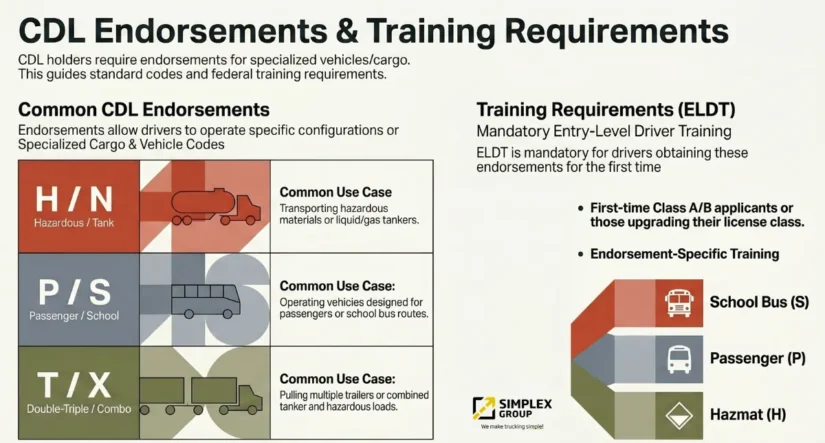
Some operations require endorsements in addition to the CDL class. Common CDL endorsements include:
| Endorsement | Common Use |
| H | Hazardous materials |
| N | Tank vehicles |
| P | Passenger vehicles |
| S | School buses |
| T | Double or triple trailers |
| X | Tanker and hazardous materials combination |
FMCSA’s Entry-Level Driver Training rules apply to drivers seeking a Class A or Class B CDL for the first time, upgrading from Class B to Class A, or obtaining school bus, passenger, or hazardous materials endorsements for the first time.
What Is a Non-CDL License?
A non-CDL license is a standard driver’s license that allows a person to operate vehicles that do not meet CDL thresholds. In commercial transportation, this may include certain cargo vans, pickup trucks, smaller box trucks, local delivery vehicles, and other vehicles under CDL weight or use requirements.
However, “non-CDL” should not be confused with “non-commercial.” A driver may operate commercially without a CDL in some situations, but the carrier may still have DOT compliance obligations.
For example, a business operating a 16-foot or 24-foot box truck may not need CDL drivers if the vehicle’s GVWR or GCWR stays below CDL thresholds and the operation does not involve hazmat or passenger transportation. But that same business may still need to manage vehicle maintenance records, driver qualification documentation, insurance filings, permits, and safety practices.
This is where many new trucking entrepreneurs get caught off guard. They start with a non-CDL vehicle to keep the barrier to entry lower, but as the business grows, their compliance responsibilities increase. In our experience supporting carriers nationwide, the companies that scale most confidently are the ones that build compliance processes before they urgently need them.
CDL vs Non-CDL: Key Differences That Matter in Real Operations
The difference between CDL and non-CDL is not limited to the license card in a driver’s wallet. It affects how a carrier hires, documents, insures, trains, monitors, and manages its operation.
1. Vehicle Weight and Combination Weight
Weight is one of the most important factors.
A CDL is commonly required when a vehicle or vehicle combination reaches certain federal weight thresholds, especially 26,001 pounds or more for GVWR or GCWR, depending on the configuration.
FMCSA describes CMV categories that include vehicles with a GVWR of 10,001 pounds or more, single or combination vehicles with a GVWR or GCWR of 26,001 pounds or more, passenger vehicles above certain thresholds, and vehicles transporting hazardous materials requiring placards.
This is why carriers must look at the manufacturer’s weight rating, not just the actual weight on a given trip. A truck may be empty today, but if its rating places it in CDL territory, the driver still needs the proper license.
2. Cargo Type
The type of cargo matters. Hazardous materials can trigger CDL requirements even when the vehicle itself is not especially large.
If the operation involves hazmat, the carrier must evaluate whether placarding is required and whether the driver needs a hazmat endorsement. This also affects background checks, training, insurance, routing, emergency response planning, and documentation.
3. Passenger Capacity
Passenger transportation has its own CDL triggers. A vehicle designed or used to transport a certain number of passengers may require a CDL, depending on capacity and whether transportation is for compensation.
This applies to buses, shuttle services, employee transportation, church vehicles, school transportation, and private passenger operations that meet regulatory thresholds.
4. Testing and Training
CDL drivers are subject to more formal testing and training requirements.
FMCSA explains that CDL applicants must pass knowledge and skills testing. To obtain a CDL, applicants may need to hold a Commercial Learner’s Permit for at least 14 days, complete the applicable ELDT, and pass the Vehicle Inspection Test, Basic Controls Test, and Road Test.
Non-CDL drivers may not face the same CDL testing structure, but carriers should still confirm that drivers are properly licensed, medically qualified when applicable, trained for the vehicle, and documented correctly.
5. Driver Qualification Files
Driver qualification files are a major compliance issue. Many carriers focus heavily on whether a driver has a CDL, but they overlook whether the company has the required supporting documentation.
Depending on the operation, a carrier may need to maintain records such as:
- Driver application
- Motor vehicle record
- Medical certificate
- Road test or equivalent documentation
- Annual review
- Prior employer inquiries
- Safety performance history
- License verification
- Drug and alcohol testing records, when applicable
At Simplex Group, driver qualification file management is one of the areas where we see carriers benefit from structured support. A license alone does not prove that a driver file is audit-ready.
6. Insurance and Risk Exposure
Insurance companies care about the type of vehicle, freight, radius of operation, driver qualifications, safety history, and claims exposure.
A CDL operation may carry different underwriting expectations than a non-CDL operation. However, non-CDL does not automatically mean low risk. A non-CDL box truck operating in dense urban areas, carrying expensive freight, or traveling interstate can still create significant exposure.
This is why the CDL vs non-CDL decision should be reviewed alongside insurance coverage. The wrong assumption can leave a carrier underinsured or misclassified.
7. Safety and CSA Performance
For regulated carriers, safety performance matters. Violations, crashes, roadside inspections, and compliance failures may affect a company’s safety profile.
A carrier that operates CDL drivers without proper files, medical cards, endorsements, or hours-of-service controls may face serious consequences. But a non-CDL operation can also accumulate safety issues if it ignores inspections, maintenance, driver screening, and documentation.
This is why Simplex Group’s compliance programs include support for areas like CSA monitoring, mock audits, HOS management, and safety performance improvement. The goal is not just to fix problems after they appear, but to help carriers operate safely and confidently from the start.
CDL vs Non-CDL for Trucking Entrepreneurs
For new trucking entrepreneurs, the CDL vs non-CDL decision often comes down to entry cost, business model, and growth strategy.
A non-CDL operation can be attractive because it may allow a business to start with smaller vehicles, lower driver hiring barriers, and simpler equipment. Common examples include cargo vans, sprinter vans, small box trucks, local delivery routes, furniture delivery, appliance delivery, and certain last-mile operations.
However, non-CDL operations still require planning. Carriers must understand:
- Whether they need a USDOT number
- Whether they need operating authority
- Whether they are operating interstate or intrastate
- Whether they need state permits
- Whether their vehicle’s weight triggers DOT rules
- Whether their drivers need medical cards
- Whether their insurance matches their operation
- Whether they must maintain driver files
- Whether hours-of-service rules apply
A CDL operation may require more upfront investment, but it can open the door to larger freight opportunities, heavier equipment, broader lanes, and more scalable trucking models.
In practical terms, the best choice depends on where the business is today and where it plans to go. We have worked with many ambitious entrepreneurs who started small and later scaled into CDL operations. The carriers that transition successfully usually have compliance systems in place before growth accelerates.
How to Decide Which License Your Business Needs
To determine whether your operation requires CDL or non-CDL drivers, review the following factors carefully.
1. Check the Vehicle’s GVWR and GCWR
Start with the vehicle rating. Do not rely only on the actual loaded weight. Check:
- GVWR on the manufacturer’s label
- GCWR for combinations
- Trailer GVWR
- Whether the combination crosses CDL thresholds
2. Review Cargo Type
Ask whether the freight includes hazardous materials and whether placards are required. Hazmat can change the licensing and endorsement requirements even for smaller vehicles.
3. Confirm Passenger Capacity
If the vehicle transports passengers, confirm the number of passengers it is designed or used to transport and whether the operation is for compensation.
4. Determine Interstate vs Intrastate Operations
Interstate commerce often brings FMCSA requirements into the picture. Intrastate operations may still be regulated by state agencies. Some states may have additional requirements beyond federal rules.
5. Evaluate Insurance Requirements
Before placing a driver in a vehicle, confirm that the operation, vehicle, freight, and driver profile match the insurance policy.
6. Build Compliance Before Dispatching
The safest approach is to set up compliance before the first load, not after a roadside inspection or audit.
That includes driver qualification files, vehicle maintenance records, safety policies, permits, tax reporting, insurance, and monitoring systems.
This is where Simplex Group supports carriers at different levels. Some businesses prefer a self-service approach through the Simplex Hub. Others need on-demand support through the Essentials Program. Larger or more complex operations may benefit from a Managed Program with a Dedicated Account Manager.
CDL vs Non-CDL Comparison Table
| Category | CDL Operation | Non-CDL Operation |
| License type | Commercial Driver’s License | Standard license, when CDL thresholds are not triggered |
| Common vehicles | Tractor-trailers, large straight trucks, buses, hazmat vehicles | Cargo vans, smaller box trucks, and local delivery vehicles |
| Weight relevance | Often 26,001 lb GVWR/GCWR or more, depending on configuration | Usually below CDL thresholds |
| Testing | CDL knowledge and skills testing required | Standard licensing requirements, unless other rules apply |
| ELDT | Applies to certain new CDL applicants and endorsements | Generally not applicable unless CDL is required |
| Endorsements | May be required for hazmat, tanker, passenger, school bus, doubles/triples | Usually not required unless the operation triggers CDL rules |
| Compliance risk | High if files, medical cards, endorsements, HOS, or testing are wrong | Still present; non-CDL does not eliminate DOT obligations |
| Insurance impact | Often more complex underwriting | May be simpler, but still depends on vehicle, freight, radius, and risk |
| Best for | Larger freight, heavier equipment, scalable trucking operations | Smaller vehicles, local delivery, entry-level commercial operations |
How Simplex Group Helps Carriers Stay Compliant
From compliance and permitting to insurance and safety, Simplex Group helps carriers keep operations running smoothly so they can focus on the road ahead.
For more than 25 years, Simplex Group has supported trucking entrepreneurs across the United States with the services they need to launch, scale, and stay compliant. That includes compliance support, permitting, tax reporting, freight planning, factoring services through Freight4U, and coverage support through Simplex Insurance.
The CDL vs non-CDL decision is a perfect example of why carriers need more than a simple answer. One business may only need guidance in setting up a non-CDL operation correctly. Another may be hiring CDL drivers, managing driver qualification files, monitoring CSA performance, preparing for audits, and expanding into new states.
Simplex Group’s Compliance Suite is designed around that reality. Whether a carrier prefers self-service tools through the Simplex Hub, on-demand support through the Essentials Program, or full-scale management through the Managed Program with a Dedicated Account Manager, the goal remains the same: help fleets stay compliant, reduce risk, improve safety performance, and keep moving forward.
FAQs
What is the main difference between CDL and non-CDL?
The main difference is that a CDL is required to operate certain commercial motor vehicles based on weight, passenger capacity, hazardous materials, or vehicle type. A non-CDL license may be enough when the vehicle and operation do not meet CDL requirements.
Do you need a CDL to drive a box truck?
It depends on the box truck’s GVWR, how it is used, whether it tows another vehicle, whether it carries passengers, and whether it transports hazardous materials. Some box trucks are non-CDL, while larger box trucks may require a CDL.
Can you drive commercially without a CDL?
Yes, in some cases. A person may drive commercially without a CDL if the vehicle and operation do not trigger CDL requirements. However, the business may still have DOT compliance obligations.
What weight requires a CDL?
A CDL is commonly required when a vehicle or combination reaches certain federal thresholds, including 26,001 pounds or more GVWR or GCWR in many situations. The exact requirement depends on vehicle type, combination, cargo, and passenger use.