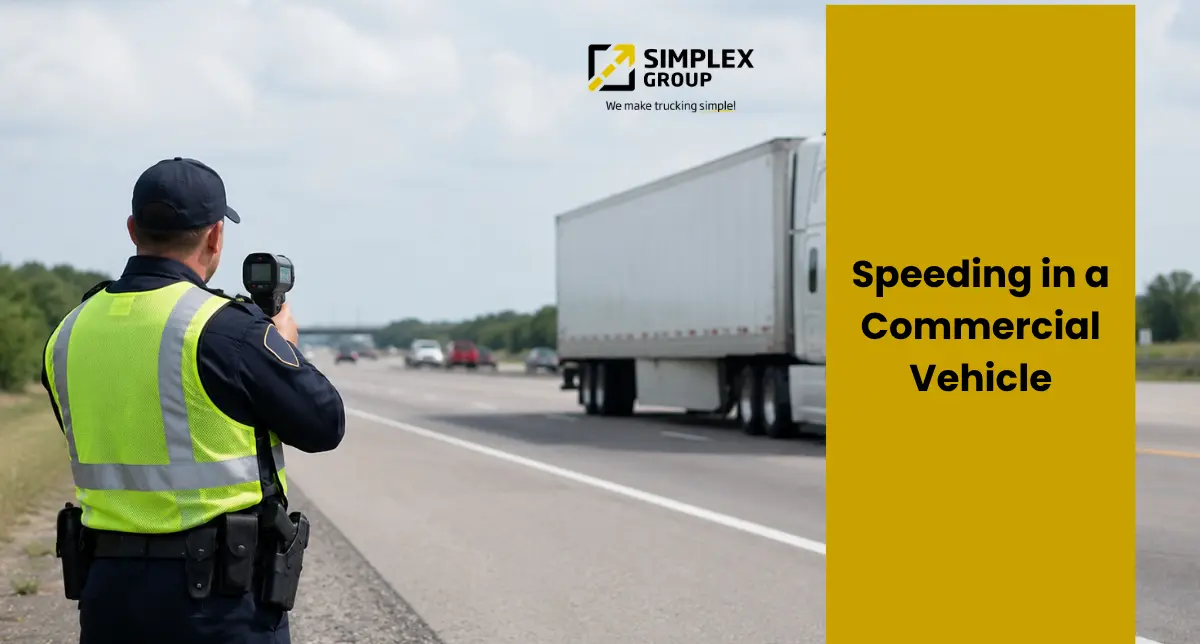
- Speeding 15 mph or more over the posted limit is a ‘serious traffic violation’ under federal regulations, two convictions within three years result in a 60-day CDL disqualification and potential loss of tens of thousands in income.
- Beyond the fine, a speeding violation raises CSA scores for 24 months and increases insurance premiums 10–35% at renewal, with the MVR impact lasting three to five years.
- Paying the fine is a guilty plea; carriers and drivers should consult a CDL traffic attorney before accepting any conviction, and file through DataQs if the violation data is inaccurate.
Table of Contents
The fine on a speeding ticket is the smallest number a commercial driver or fleet owner should be thinking about. For a CDL holder, a single speeding citation carries consequences that follow the driver’s record for up to three years, raise the carrier’s CSA score, push insurance premiums higher, and in serious cases, put a CDL at risk entirely.
Understanding what actually happens after a speeding stop to the driver, the carrier, and the business is the only way to make an informed decision about how to respond.
Federal Violation Tiers
The FMCSA classifies speeding violations for CMV drivers into tiers based on how far above the posted limit the driver was traveling. The tier determines the regulatory consequence.
Any speed above the posted limit generates a violation that feeds into the FMCSA SMS Unsafe Driving BASIC. But the threshold that separates a standard violation from a career-level event is 15 mph over the posted limit. At that point, the violation becomes a “serious traffic violation” under 49 CFR 383.51.
Two serious traffic violations within three years result in a 60-day CDL disqualification. Three serious traffic violations within three years result in a 120-day disqualification. For an owner-operator earning $5,000 to $8,000 per week, a 60-day disqualification translates directly to $40,000 to $64,000 in lost revenue plus fixed costs like truck payments, permits, and insurance that continue regardless.
The CSA Score Consequence
Speeding is the number-one driver behavior violation across the trucking industry, and it falls squarely under the Unsafe Driving BASIC in the FMCSA’s Safety Measurement System. Every speeding violation recorded during a roadside inspection adds severity points to the carrier’s profile. Those points are time-weighted a violation from last month counts more than one from 20 months ago.
For large fleets with hundreds of inspections per year, a single violation gets diluted across a larger sample. For small carriers and owner-operators with fewer inspections on record, one serious speeding citation can move the CSA percentile dramatically. Combined with other violations in the same 24-month window, the cumulative effect can push a carrier above FMCSA intervention thresholds.
The Insurance Consequence
Insurance companies pull Motor Vehicle Records and CSA data when setting or renewing trucking policies. Speeding violations translate directly into premium increases at renewal.
For minor speeding violations (1 to 14 mph over), expect premium increases in the range of 10 to 20 percent. For serious speeding (15 mph or more over), premium increases of 20 to 35 percent are common. For an owner-operator already paying $12,000 to $18,000 per year in commercial truck insurance, that increase adds $2,400 to $6,300 to annual operating costs, every year the violation remains on record.
The violation stays on the Motor Vehicle Record for three to five years, which is longer than the 24-month window in the FMCSA SMS. That means even after a violation drops out of the CSA calculation, it continues affecting employability and insurance rates.
Simplex Group’s insurance specialists work with trucking businesses that have complex records, carriers with violations, new authorities, and established fleets navigating rate increases after enforcement events. Our goal is always to find coverage that fits the actual risk profile of the business, not just the worst-case scenario.
The Employment and Contract Consequence
Fleets that use PSP (Pre-employment Screening Program) reports will see speeding violations when evaluating new drivers. Carriers with a clean PSP record have measurably better safety outcomes: FMCSA data shows that using PSP reports in hiring reduces crash rates by 8 percent and driver out-of-service rates by 17 percent.
For owner-operators leased to a motor carrier, a serious speeding conviction can result in immediate removal from service. Many fleet managers will not hold a position open during a 60-day CDL disqualification. Beyond employment, shippers and brokers who monitor CSA data will see elevated Unsafe Driving percentiles and may route loads to carriers with cleaner records.
The State-Level Fine Reality
The base fine on a speeding ticket is only the starting point. States add penalty assessments, court surcharges, and processing fees that can multiply the total by three to five times. In California, a speeding ticket that looks like a $100 fine on the citation can total $274 to $567 or more after all court assessments under the 2026 Judicial Council schedule. In some states, speeding at 20 mph or more over the limit is classified as a criminal misdemeanor for commercial drivers, which carries potential for fines in the thousands, mandatory court appearances, and in rare cases, probation.
Paying the fine without contesting it is the same as entering a guilty plea. The conviction goes on the driver’s MVR, adds CSA points to the carrier, and becomes the baseline from which insurance companies calculate the next renewal premium.
What Drivers and Carriers Should Do After a Speeding Stop

Do Not Simply Pay the Ticket
Paying the fine accepts the conviction. Before taking any action, the driver and carrier should review the violation code, the jurisdiction, and whether the stop was documented correctly. A CDL-specialized traffic attorney can often negotiate a reduction to a non-moving violation, such as a defective equipment citation, that avoids CSA points entirely. Attorney fees typically range from $250 to $1,500, which is a fraction of the downstream insurance cost of a conviction.
File Through DataQs If the Violation Is Inaccurate
If the speed cited does not match what the driver recorded, or if the officer’s documentation contains errors, carriers can challenge the violation through the FMCSA DataQs system. The April 2026 overhaul of the DataQs process now requires a mandatory three-stage independent review, which has improved the fairness of the challenge process for carriers who file with thorough documentation.
Build a Culture That Prevents the Next One
Simplex Group’s compliance services include driver qualification file management and monitoring tools through our Simplex Hub platform, which gives fleet managers real-time visibility into driver records and compliance status. For carriers coming off a period of elevated CSA scores, building a consistent pre-trip briefing and driver coaching program is the most effective long-term fix.
Frequently Asked Questions
Does a speeding ticket from a state where the driver does not live still affect the CDL?
Yes. Under federal regulations, CDL holders are required to notify their state DMV and their employer of any traffic conviction within 30 days, regardless of the state where it occurred. The conviction becomes part of the driver’s MVR in their home state and is reported to the FMCSA.
If a driver takes a defensive driving course, does it remove a speeding violation from the CSA record?
Defensive driving courses may reduce or mask points on a state DMV record in certain jurisdictions, but they do not remove a violation from the FMCSA Safety Measurement System. Corrections to the SMS can only happen through a successful DataQs challenge or through the passage of time.
How does a speeding violation during Safe Driver Week differ from a regular roadside citation?
It does not. A citation issued during Operation Safe Driver Week carries the same regulatory weight as any other roadside violation. What changes during enforcement events is the volume of stops and the heightened attention law enforcement places on commercial vehicles, which increases the statistical likelihood of any driver being cited.