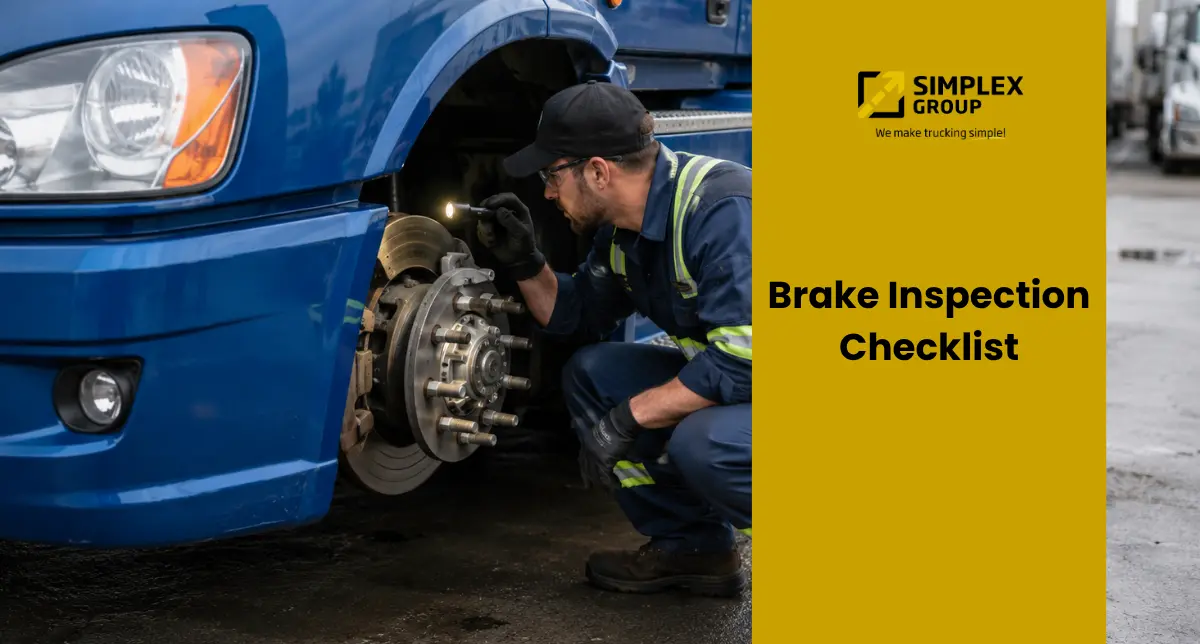
- CVSA’s 2026 Brake Safety Week focus area is drum and rotor condition, but a complete fleet check still needs to cover air leaks, slack adjusters, pads, ABS, and mounting hardware.
- This checklist is built to be assigned by unit across a fleet and tracked centrally, since individual driver pre-trips alone typically can’t catch drum/rotor thickness issues without measurement tools.
- Documenting every checklist item with date, technician, and unit number turns a routine inspection into evidence that supports a compliance or insurance dispute later.
Table of Contents
With Brake Safety Week running August 23-29, fleet managers have a narrow window to get every unit inspection-ready. This checklist is built to be assigned across a fleet, component by component, with what an inspector is actually looking for at each point, so drivers and shop staff know exactly what “ready” looks like before the enforcement window opens.
Before You Start: What’s Different This Year
CVSA’s 2026 focus area is brake drums and rotors specifically, meaning inspectors are giving those components extra scrutiny beyond the standard brake system check. Build your fleet review around that emphasis while still covering the full checklist below, a fleet that only checks drums and rotors and skips air leaks or slack adjusters is still exposed.
Air System
- ☐ Build to full operating pressure and confirm the system holds within spec with the engine off and brakes applied for the required test period
- ☐ Listen for audible leaks at the compressor, supply lines, fittings, and brake chambers
- ☐ Check low-air-pressure warning devices activate at the correct psi threshold
- ☐ Inspect air lines for chafing, cracking, or improper routing near moving parts
Slack Adjusters and Pushrod Travel
- ☐ Measure pushrod travel at each wheel end against the legal limit for that chamber size
- ☐ Confirm automatic slack adjusters are functioning — manual adjustment of an automatic slack adjuster masks a failing component rather than fixing it
- ☐ Check for visible damage, looseness, or improper installation at the adjuster itself
Brake Pads and Linings
- ☐ Measure remaining lining thickness at each wheel end against the manufacturer minimum
- ☐ Check for oil or grease contamination on friction surfaces
- ☐ Inspect for cracking, chunking, or separation from the shoe or backing plate
Drums and Rotors — 2026 Focus Area
- ☐ Measure drum and rotor thickness against manufacturer minimum specification
- ☐ Inspect for cracks, with particular attention to any extending from the outer edge toward mounting holes
- ☐ Check for heat checking, scoring, or bluing indicating overheating or dragging brakes
- ☐ Confirm no structural damage or separation is visible through inspection openings
ABS
- ☐ Confirm the ABS malfunction lamp illuminates briefly at startup, then goes off after self-check
- ☐ Flag any unit where the lamp stays on, flickers, or fails to illuminate at all
- ☐ Check wheel speed sensor wiring and connectors for damage or corrosion, especially on units running rough yard surfaces or coastal routes
Brake Chambers and Mounting Hardware
- ☐ Check for loose, missing, or damaged mounting bolts
- ☐ Inspect chambers for cracks or damage
- ☐ Confirm all components match manufacturer specification — mismatched or incorrectly sized hardware is a citable defect on its own
Documentation
- ☐ Log every item checked with date, technician, and unit number — not just a pass/fail note
- ☐ Flag and schedule repair for anything borderline rather than waiting for it to fail outright
- ☐ Keep repair records accessible for drivers in case of a roadside dispute over a previously corrected issue
Assigning This Checklist Across a Fleet
For fleets running more than a handful of units, the highest-leverage move before August 23 is assigning this checklist by unit and tracking completion centrally, rather than relying on individual driver pre-trips to catch everything. A driver’s daily pre-trip is a valuable first layer, but it isn’t a substitute for a documented, component-level inspection ahead of a known enforcement week, especially for drum and rotor thickness, which requires measurement tools most drivers don’t carry.

How Simplex Group Supports Fleet-Wide Inspection Readiness
Simplex Group works with fleets to align maintenance documentation with DOT compliance and CSA reporting, so a completed inspection checklist doesn’t just sit in a shop folder — it becomes part of the record that supports your compliance and insurance position if a violation is ever disputed.
FAQs
Can drivers perform drum and rotor thickness measurements themselves?
It requires specific measurement tools most drivers don’t carry as standard pre-trip equipment, so this item is typically best assigned to shop technicians ahead of the enforcement window rather than relegated to a driver’s daily pre-trip.
How often should this full checklist be run outside of Brake Safety Week?
Most fleet maintenance programs run a full component-level brake inspection at every scheduled PM interval, commonly every 25,000-35,000 miles depending on operation type, independent of any enforcement campaign.
What’s the fastest item on this checklist for a shop to check?
ABS lamp verification and audible air leak checks are both fast, tool-free checks that can be done in a few minutes per unit, making them efficient items to run across an entire fleet quickly before a known inspection window.