- Fuel taxes in the U.S. include a federal rate plus state-level rates that vary widely, especially for diesel and commercial transportation.
- For truckers and fleet operators, fuel taxes are not just a cost issue; they are also a compliance and reporting issue that can affect operations.
- Understanding state differences, keeping accurate records, and filing correctly can help reduce risk and keep your business moving.
Table of Contents
Fuel taxes are a basic part of operating any vehicle in the United States, but for trucking businesses, they carry more weight than a simple line item at the pump. They affect operating costs, route planning, reporting accuracy, and overall compliance.
The federal government taxes gasoline at 18.4 cents per gallon and diesel at 24.4 cents per gallon, while states apply their own motor fuel taxes on top of that. State rates vary significantly, and some states also apply additional sales taxes or related fees.
For owner-operators, fleet owners, trucking companies, logistics providers, and shipping businesses, understanding fuel taxes is important for more than budgeting. It helps prevent filing errors, missed deadlines, and compliance issues across jurisdictions. That is where a structured tax and compliance process becomes essential.
What Are Fuel Taxes?
Fuel taxes are taxes charged on motor fuels such as gasoline, diesel, and gasohol. In practical terms, they are imposed on each gallon purchased and are built into the price paid at the pump in the United States. At the state and local level, motor fuel taxes generated $53 billion in 2021, and nearly all of that revenue came from state-level motor fuel taxes.
For trucking businesses, the most relevant point is simple: fuel taxes are part of the cost of operating across the country, and those costs are not uniform. Diesel rates can differ from gasoline rates, and the state where fuel is purchased matters. This creates a real compliance challenge for carriers that operate in multiple states.
Fuel taxes also serve a public financing purpose. A large share of these revenues supports roads, highways, bridges, and transportation infrastructure. That broader function explains why fuel taxes remain a major part of transportation policy, even though rates and structures differ by jurisdiction.
How Fuel Taxes Work in the United States
Fuel taxes in the U.S. work through a layered system. There is a federal fuel tax, and then every state, plus the District of Columbia, imposes its own fuel tax. The result is a combined tax burden that changes from one state to another.
At the federal level, the rates are straightforward:
| Fuel Type | Federal Rate |
| Gasoline | 18.4¢ per gallon |
| Diesel | 24.4¢ per gallon |
State fuel taxes are more complicated. Most states still use a cents-per-gallon model, but many states tie at least part of their rate to a variable such as fuel prices, inflation, or another metric. The Tax Policy Center notes that 22 states and the District of Columbia do this in some form. That means rates may shift over time and cannot always be treated as static.
There is also an important distinction between excise taxes and sales taxes on fuel. Some states charge a sales tax on top of the gasoline excise tax. The 2025 state motor fuel rate table specifically notes this for California, Connecticut, Illinois, Indiana, and Michigan. For trucking and logistics businesses, that distinction matters because the real tax burden at the pump may be higher than the base excise rate alone suggests.
Why Fuel Taxes Matter for Trucking Businesses
Fuel taxes matter because they directly affect cost control, reporting accuracy, and compliance exposure. A small difference in cents per gallon becomes a much larger issue when a business buys large fuel volumes across several states.
For example, a company running regional or multi-state routes may see meaningful differences depending on where diesel is purchased. In the 2025 state rate table, Pennsylvania diesel is listed at 74.1 cents per gallon, while states such as Texas and Louisiana are much lower at 20 cents per gallon. Those gaps can influence planning, fuel purchasing strategy, and margin management.
Fuel taxes also matter because they connect to reporting responsibilities. A trucking company that purchases fuel in one state and operates in several others needs accurate records to support proper tax handling. That is why fuel tax management should never be treated as just an accounting afterthought.
From a compliance perspective, the real risk is not only paying more at the pump. The risk is making preventable errors in tax services, filings, and deadlines. Businesses that want to stay focused on growth need a process that keeps them aligned with state and federal requirements.
This is one of the reasons many carriers rely on specialized support: when fuel tax reporting is handled correctly and on time, business owners can spend more time running operations and less time correcting avoidable tax problems.
Common Fuel Tax Compliance Mistakes to Avoid
The most common fuel tax mistakes are avoidable, but they can create unnecessary exposure when a business operates across jurisdictions.
Common mistakes include:
- Using outdated state fuel tax rates
- Treating all states as if they apply fuel taxes the same way
- Failing to separate gasoline and diesel treatment when rates differ
- Ignoring additional sales tax layers in certain states
- Keeping incomplete fuel purchase records
- Filing late or with inconsistent data
- Assuming fuel tax compliance is only a bookkeeping issue instead of an operational one
These mistakes happen because fuel taxes look simple on the surface. A rate per gallon seems easy enough, but the rules become more complex when multiple states, multiple fuel types, and reporting obligations enter the picture.
For trucking companies, a better approach is to treat fuel tax compliance as part of a broader DOT and tax discipline. That means accurate documentation, calendar control, timely filings, and expert review when the reporting process becomes difficult. Businesses that build that discipline early are in a better position to avoid penalties and stay focused on growth.
How to Stay Compliant With Fuel Tax Reporting
The best way to stay compliant is to combine accurate records, current state tax knowledge, and a consistent filing process. Fuel tax compliance becomes much easier when it is handled as a repeatable system rather than a last-minute task.
A practical framework looks like this:
- Track fuel purchases accurately by state and fuel type.
- Use current rates instead of relying on old tables or assumptions.
- Review state-specific rules when operating across multiple jurisdictions.
- Keep filing calendars and deadlines under control so taxes are paid on time.
- Work with specialists when reporting becomes complex or high-risk.
For many carriers, the challenge is not understanding that taxes exist. The challenge is managing the process correctly every time. Simplex Group works with tax experts who help businesses through the reporting process, make sure tax services are handled properly, and support compliance with state and federal requirements. That kind of support can make a real difference for owner-operators and fleets that want to stay compliant while continuing to grow.
State gasoline tax rates (cents per gallon, 2025)
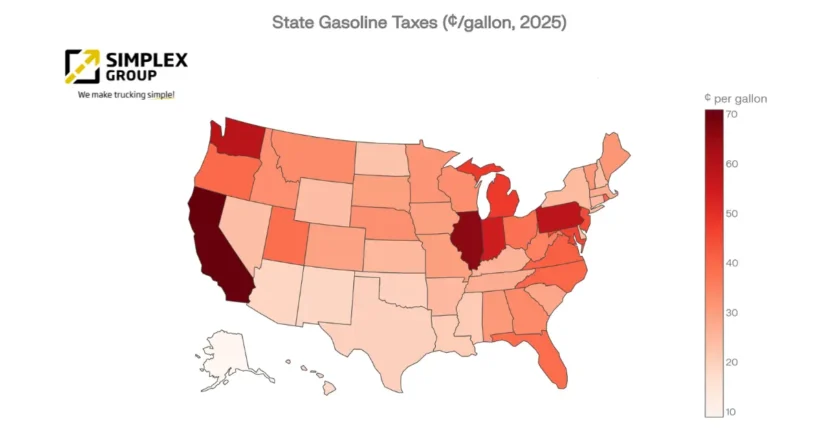
The following table lists the 2025 gasoline tax rate for each U.S. state and the District of Columbia, in cents per gallon. Source: WorldPopulationReview
FAQs
What is the fuel tax in the U.S.?
The U.S. fuel tax includes both a federal rate and state-level taxes. Federal tax is 18.4 cents per gallon for gasoline and 24.4 cents per gallon for diesel, and each state adds its own rate on top.
Are fuel taxes the same in every state?
No. Fuel tax rates vary widely by state, and some states also apply additional sales taxes or variable formulas tied to inflation or fuel prices.
Why is diesel taxed differently from gasoline in some states?
States can set different rates for diesel and gasoline based on their own tax structures and transportation funding policies. The 2025 rate table shows many states where diesel is taxed at a different rate than gasoline.
How much is the Tennessee gas tax?
Tennessee gasoline tax is 27.4 cents per gallon in the 2025 state motor fuel rate table.
How much is the Washington state gas tax?
Washington’s gasoline tax is 49.4 cents per gallon in the 2025 state motor fuel rate table
Is fuel tax the same as sales tax on fuel?
Not always. Fuel tax usually refers to excise tax per gallon, but some states also charge sales tax or a similar tax on top of the excise tax.