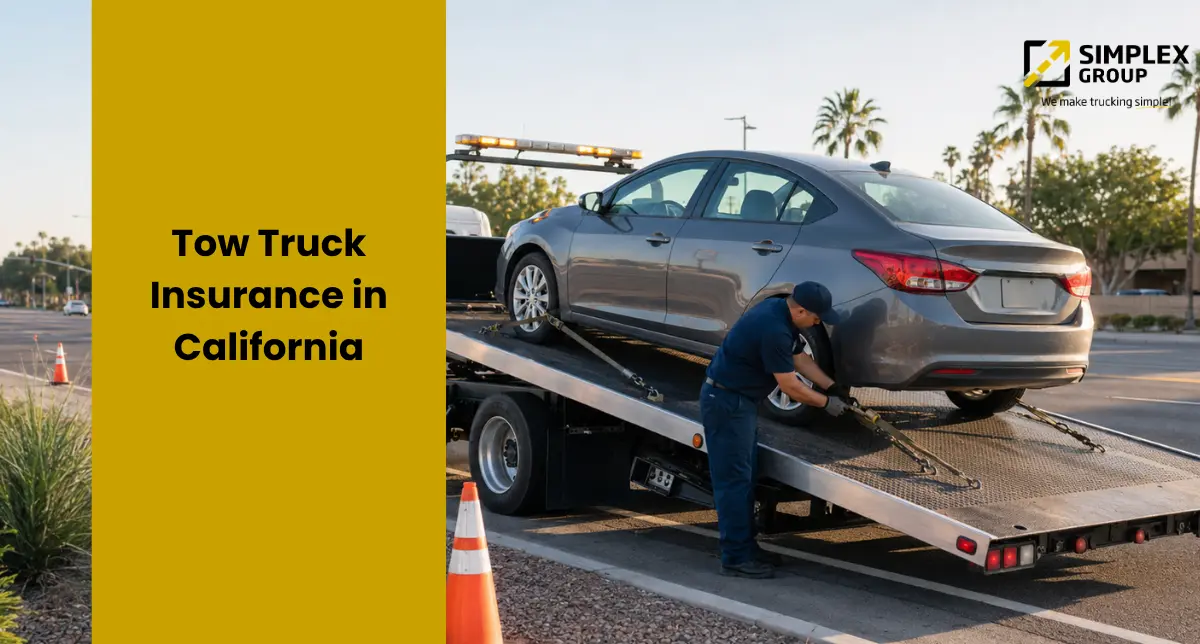
- California tow truck operators must carry primary liability (minimum $750K, most contracts require $1M), on-hook towing coverage, and garagekeepers legal liability; standard commercial auto policies do not cover these exposures.
- 2026 California tow truck insurance ranges from $8,000 to $22,000 per year per truck, depending on truck class, with repossession operations and new authorities pricing at the higher end due to elevated risk profiles.
- CHP rotation and motor club contracts require coverage structures that exceed state minimums; operators pursuing these contracts should structure their policy to meet the most demanding requirements before applying.
Table of Contents
Tow truck operators in California face a more complex insurance environment than most commercial vehicle businesses in the country. California layers state-specific requirements on top of federal FMCSA minimums, and the state’s litigation frequency and high claim severity make it one of the most expensive commercial auto markets in the nation.
Whether you operate a single flatbed doing roadside assists in the Inland Empire, manage a fleet handling CHP rotation calls across Southern California, or run repossession services in the Los Angeles metro, understanding exactly what coverage you need is the starting point for building a compliant, financially protected operation.
California State Insurance Requirements for Tow Trucks
California tow truck operators must meet both federal and state-level coverage requirements. The federal FMCSA sets minimum liability standards for interstate operations, while the California DMV administers the Motor Carrier Permit (MCP) program for in-state operations.
For tow trucks operating as for-hire carriers in California:
- Primary liability: Minimum $750,000 CSL for general freight operations over 10,001 pounds; most motor clubs and CHP contracts require $1,000,000
- On-hook towing coverage: Required in California for any operation that tows non-owned vehicles. This coverage protects the customer’s vehicle while it is on your truck or behind your wrecker
- Garagekeepers legal liability: Required if you store vehicles at an impound lot or repair yard. Covers damage to customer vehicles in your care from fire, theft, vandalism, or weather events
- Workers’ compensation: Required for any employees, mandatory in California
- Motor Carrier Permit (MCP): Required from the California DMV. You must obtain a CA# from the CHP and provide proof of insurance to complete the MCP application

California’s minimum auto liability as of 2025 was updated to $30,000/$60,000/$15,000 under SB 1107, but these minimums apply to private vehicles; commercial carriers operating under MCP or FMCSA authority must meet the higher commercial thresholds above.
Coverage Types Specific to Tow Operations
Tow truck insurance requires several coverages that do not exist in standard commercial auto policies. Each addresses a specific risk exposure unique to the towing industry.
On-Hook Towing Coverage
On-hook coverage protects the customer’s vehicle while it is physically in your custody, loaded on the flatbed, hooked behind a wrecker, or being moved from an accident scene. If the vehicle is damaged during transport, on-hook coverage pays the claim. Standard auto liability does not cover vehicles in your care, custody, or control. Typical coverage limits run from $50,000 to $150,000 per vehicle. Motor clubs like AAA and Agero typically require at least $100,000 in on-hook limits before they will add a tow operator to their dispatch network.
Garagekeepers Legal Liability
If your operation includes impound storage, long-term lot holding, or post-accident vehicle storage, garagekeepers’ liability protects customer vehicles in your yard from fire, theft, vandalism, and weather damage. On-hook coverage stops when the vehicle is unloaded. If a car sits in your lot for two weeks waiting for the owner’s release and gets damaged in that time, the garagekeepers are what pays for it. Most operators calculate their lot exposure and buy limits accordingly. Holding 20 to 30 vehicles at $15,000 to $40,000 each creates $300,000 to $1.2 million in exposure. The standard $100,000 in garagekeepers coverage leaves most operators significantly underinsured.
Physical Damage
Tow trucks themselves are expensive equipment; heavy-duty rotators and flatbeds range from $100,000 to $400,000. Physical damage coverage protects against collision, fire, theft, and vandalism on the truck itself. For financed equipment, lenders require this coverage. For paid-off equipment, the cost of replacement without coverage is a risk most operators cannot absorb.
What Tow Truck Insurance Costs in California in 2026
California is one of the most expensive states for commercial vehicle insurance nationally, and tow truck operations carry additional risk exposure compared to standard freight carriers because of on-hook liability and lot storage exposure.
2026 cost ranges for California tow operators:
- Light-duty flatbed tow truck (Class 4–5): $8,000 to $13,000 per year
- Medium-duty wheel-lift or wrecker (Class 6–7): $10,000 to $15,000 per year
- Heavy-duty rotator or recovery truck (Class 8): $14,000 to $22,000 per year
- Repossession operations: $12,000 to $20,000 per year (higher due to confrontation risk)
- Fleet of three to five trucks: $7,000 to $11,000 per truck per year with fleet discounts
New operations and operators with a violations or claims history pay significantly more. California’s litigation environment, with nuclear verdicts (jury awards exceeding $10 million) rising sharply in recent years, has pushed premiums above the national average and contributed to a tighter market with fewer carriers willing to write new tow operations.
Factors That Affect Your Premium
California tow truck insurance premiums are set based on a risk profile that includes:
- Garaging ZIP code: Los Angeles, Bay Area, and San Diego ZIPs carry territory surcharges of 15 to 30 percent over Inland Empire or rural California rates
- Type of tow work: repossession and heavy recovery operations are priced significantly higher than standard roadside assistance
- Driver history and experience: less than two years of CDL experience or a recent at-fault accident can substantially increase premiums
- Loss history: a single at-fault accident in the past three years typically increases rates 25 to 60 percent
- CHP rotation status: operators on CHP rotation lists must meet specific insurance requirements exactly, and coverage must be verified and current
- Motor club contracts: AAA, Agero, and Honk typically require $1,000,000 in liability and $100,000 in on-hook coverage, plus named additional insured status
CHP Rotation and Motor Club Requirements
Two of the most valuable contracts available to California tow operators, CHP rotation and motor club dispatch networks, both carry specific insurance requirements that go beyond state minimums. For CHP rotation, the requirements include minimum insurance limits, yard inspections, equipment standards, and storage facility specifications. Insurers underwriting CHP rotation operators must be approved to write those programs.
For motor club work, each club sets its own requirements, but most require at least $1,000,000 in liability, $100,000 or more in on-hook coverage, and named additional insured status on the policy. Carriers who want to work with multiple motor clubs may need to structure their policy to meet the strictest requirements across all contracts.
Simplex Group Insurance: Serving California Trucking Businesses
Simplex Group’s insurance division has been protecting commercial trucking and transportation businesses across the United States for more than 25 years. Our Rancho Cucamonga office serves the Inland Empire corridor and Southern California’s trucking market, with specialists who understand the specific requirements of California operators — from MCP filings to CHP rotation coverage structures.
We work with tow operators who are launching their first truck, expanding into heavier recovery work, or managing a fleet looking for better rates at renewal. Our team reviews your full operation to make sure coverage is structured to meet your contracts, protect your equipment, and keep your business running when a claim happens.
Frequently Asked Questions
Do California tow operators need a PUC filing in addition to the Motor Carrier Permit?
The California Public Utilities Commission (CPUC) regulates passenger transportation, not tow trucks. Tow truck operators in California are regulated under the California DMV’s Motor Carrier Permit program, not CPUC. You need an MCP from the DMV and a CA# from the CHP, not a CPUC permit. If your operation includes any passenger transport component, that changes the regulatory picture.
Is repossession towing covered under a standard tow truck insurance policy?
Not always. Repossession operations involve confrontation risk that many standard carriers decline or surcharge significantly. If you perform repo work, you need to disclose that to your broker upfront. Specialty markets exist for repo operations, but coverage must be explicitly structured to include that exposure — it will not be assumed under a general tow policy.
How does CARB compliance affect tow truck insurance in California?
California’s Advanced Clean Fleets regulation requires medium and heavy-duty operators to transition to zero-emission vehicles on a phased schedule. Non-compliant diesel vehicles over 8,500 pounds GVWR face registration restrictions and fines. Insurance carriers are increasingly requiring proof of CARB compliance before binding coverage, and non-compliant fleets may face surcharges or declination in the admitted market.