
In this article you will find:
- What the 2026 USPS CDL policy change means for contracted trucking providers and why non-domiciled CDLs are being phased out.
- How the new Postal Inspection Service vetting process may affect driver qualification, documentation, and compliance readiness.
- Practical steps carriers should take now to audit Driver Qualification Files (DQFs), track medical certifications, and prepare for stricter eligibility standards.
Table of Contents
What’s actually changing with the USPS Commercial Driver License
If you’ve been operating in the USPS contractor ecosystem, you already know the standard is not “close enough.” It’s documented, verifiable compliance, every time. The current attention on CDL validity and driver qualification is not a theoretical policy debate; it affects whether your company can keep capacity on the road and remain eligible for contracted work.
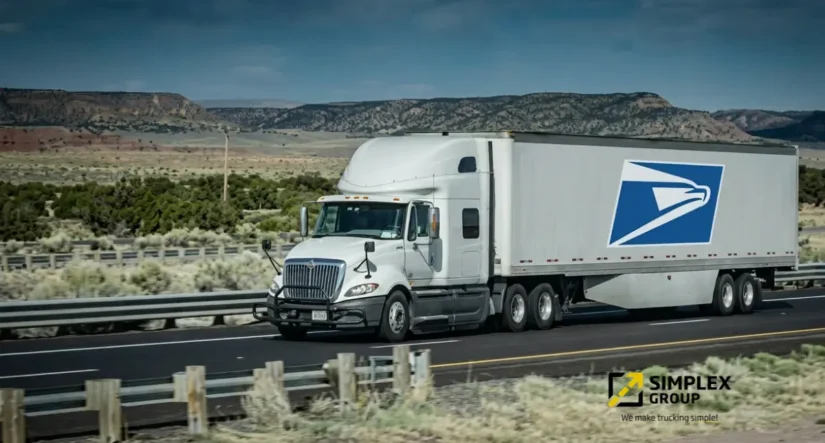
In its January 5, 2026 announcement, USPS stated it is strengthening requirements for contracted trucking providers, including phasing out acceptance of non-domiciled Commercial Driver’s Licenses (CDLs) for contractors, and implementing enhanced vetting through the Postal Inspection Service. USPS also frames these moves as aligned with the U.S. Department of Transportation (DOT) action and broader safety and integrity goals.
From a DOT compliance perspective, any time a shipper (or, in this case, a federal mailing operator relying on contractors) tightens eligibility criteria, the practical impact lands in three places:
- your recruiting funnel,
- your Driver Qualification Files (DQFs) and ongoing monitoring, and
- your ability to demonstrate “control” over qualification standards across your contractor workforce.
In my work supporting carriers on compliance operations, the biggest problems rarely come from a single missing document. They come from systems that fail: outdated files, expired medical cards, and inconsistent verification processes
USPS employees vs. USPS contracted trucking providers
The USPS announcement is focused on contracted trucking providers, not USPS career employees. That means:
- highway contractors hauling mail
- subcontractors operating under prime contracts (where applicable)
- and any carrier providing capacity as part of USPS’s contracted transportation network
If your company is bidding on, renewing, or currently executing USPS transportation work, you should treat this as an immediate compliance-readiness issue. Even if you are not a USPS contractor today, these shifts often influence other shipper policies because they raise the baseline for what “acceptable qualification” looks like.
What is a “non-domiciled CDL” and why USPS is phasing it out
A “non-domiciled CDL” generally refers to a CDL issued by a U.S. state to a driver who is not domiciled in that state, often tied to specific immigration status or documentation pathways. The USPS announcement indicates it will phase out acceptance of these CDLs for contractor operations.
From a compliance standpoint, the operational challenge is not the terminology; it’s the transition period:
- What will USPS accept during the phase-out?
- What proof will be required for drivers who currently hold non-domiciled CDLs?
- How will contractors demonstrate that their driver population meets the new eligibility standards?
Those are questions that can create uncertainty for recruiting and retention if you do not have a structured plan. FreightWaves’ coverage emphasizes how the issue intersects with regulatory momentum, enforcement posture, and capacity concerns across contractor networks.
What “Postal Inspection Service vetting” implies for contractors
USPS states that vetting will be conducted through the Postal Inspection Service. While the exact checklist can evolve, “vetting” in a contractor context typically means you must be prepared to demonstrate:
- driver identity validation and eligibility
- consistent documentation standards across the fleet
- disciplined recordkeeping, retention, and accessibility
- and an ability to show proactive monitoring (not just point-in-time hiring paperwork)
Practically, this is where many otherwise good carriers get exposed. Hiring a qualified driver is step one. Maintaining qualification, medical certification validity, MVR monitoring, incident documentation, hours-of-service compliance, and audit-ready files is what determines whether you can sustain eligibility under scrutiny.
This is exactly why many trucking businesses lean on compliance partners. When you’re running dispatch, chasing loads, and managing equipment, the compliance workload doesn’t slow down. It compounds. In my experience, the simplest way to reduce risk is to make qualification “automatic”: standardized files, expiration tracking, and documented verification routines that can be produced on demand.
Compliance fundamentals USPS contractors should tighten immediately
Even if USPS’s specific phase-out timeline has operational nuance, contractors can act now on the parts that always matter in DOT compliance:
1) Driver Qualification File (DQF) integrity and standardization
Your DQF process should be consistent across every driver and every terminal. You want:
- a standardized DQF checklist
- internal QC (quality control) sign-off
- and an audit trail showing when documents were reviewed and verified.
If you are hiring at scale, you cannot rely on “tribal knowledge” or ad hoc folder structures. You need a repeatable system.
2) Medical certification and ongoing monitoring
Expired med cards are one of the most common and preventable compliance failures. Your process should include:
- pre-hire verification
- ongoing alerts before expiration
- and documentation that the carrier took action
3) Vehicle inspection discipline and hours-of-service documentation
USPS contracting is operationally demanding. You should assume that log integrity and inspection routines will be examined more aggressively when broader eligibility rules tighten. If you don’t already run internal log audits and equipment inspection checks, build that muscle now.
4) Subcontractor controls (if applicable)
If you use owner-operators or subcontractors, your responsibility is not reduced; your risk often increases. You need documented standards and verification routines that apply to every driver operating under your umbrella.
A practical action plan before your next USPS review
Here’s the compliance roadmap I recommend to contractors and carriers who want to stay ahead of customer eligibility changes:
This week: stabilize your compliance baseline
- Identify any drivers with non-domiciled CDLs in your roster.
- Run a DQF spot audit (10–20% sample) to find systemic gaps.
- Confirm medical card expirations and create a 60–90 day alert window.
This month: convert your process into a system
- Implement a standardized DQF checklist with QC sign-off.
- Centralize storage (secure, access-controlled) so files are retrievable quickly.
- Train hiring staff on “documentable verification,” not assumptions.
Before your next USPS contract event (renewal, audit, onboarding)
- Prepare an “audit-ready package” that demonstrates:
- your qualification standards
- your monitoring and retention process
- and your ability to produce proof quickly.
This is where a firm like Simplex Group can materially reduce friction: keeping driver records on file, maintaining them up to date, and ensuring drivers remain qualified while you focus on operations and revenue. When a customer tightens standards, companies that already run clean compliance systems don’t scramble, they execute.
Recruiting and capacity implications
From a business perspective, you should treat the change as both:
- a compliance risk, and
- a recruiting constraint.
To reduce disruption:
- diversify recruiting channels
- tighten pre-hire screening
- and avoid “last-minute qualification” by building a pipeline of drivers whose documentation is already audit-ready
Common mistakes that create compliance exposure
In compliance work, patterns repeat. The most common failures I see in fleets preparing for tightened customer requirements are:
and failing to document verification steps (you did it, but can’t prove it)
treating DQFs as static “hire packets” instead of living files
relying on manual reminders for expirations
mixing standards across terminals or recruiters
FAQs
Does this apply to all CDL holders or only certain types?
USPS specifically references phasing out acceptance of non-domiciled CDLs for contracted trucking providers. Your next step is to identify whether any drivers in your roster fall into that category and prepare transition plans
Is this a DOT rule or a USPS contracting requirement?
USPS frames the policy as aligned with DOT action, but the operational reality is that it functions as a USPS contractor eligibility requirement.
What should I prepare for “vetting”?
At minimum: audit-ready DQFs, consistent verification routines, expiration monitoring, and the ability to produce documentation quickly and securely. USPS states the Postal Inspection Service will conduct vetting.
How can I keep driver records audit-ready without overloading my team?
Standardize your DQF process, centralize records, and automate monitoring. Many carriers also use compliance partners to keep driver files current so operations can stay focused on hauling and service performance.