
Table of Contents
What’s Happening to Truck Capacity in H2 2026?
For the first time in over four years, dry van spot rates have overtaken contract rates. That’s not a fluke, and it isn’t being driven by a surge in shipments.
It’s being driven by trucks leaving the market and not coming back.
This is the core shift small carriers need to understand heading into H2 2026:
- Demand = relatively flat across most sectors
- Truck capacity = shrinking, permanently, due to regulation
- Result = carriers, not shippers, are starting to set the terms
Aggregated DAT data via ACT Research (May 2026) shows contract rates climbing nearly 10% year-over-year, while spot rates moved above them for the first time since February 2022. Unlike the 2020–2021 boom, which was driven by a demand explosion, this cycle is being driven almost entirely by supply exiting the market.
Two Signals That Just Flipped the Market
Two things happened this summer that haven’t happened together since 2022:
- Dry van spot rates rose above contract rates in June 2026, with reefer briefly doing the same. Shippers are now willing to pay a premium for spot capacity.
- Tender rejections hit their highest point since 2022. Carriers are turning down loads because they have better options — a clear sign of pricing power shifting their way.
Rising rejections mean carriers, not shippers, are setting the terms.
The Central Tension: This Is Supply-Driven, Not Demand-Driven
As one mid-year industry analysis put it, this is a supply-led market shift driven by regulatory enforcement — rates are rising, but not because of surging demand.
That distinction matters. A demand-driven boom can reverse the moment shippers pull back. A supply-driven shift is stickier, because the truck capacity that has exited isn’t coming back quickly. Compliance costs, licensing barriers, and equipment replacement all make re-entry slower and harder than it used to be.
Segment Breakdown: Dry Van, Reefer, and Flatbed Rates in 2026
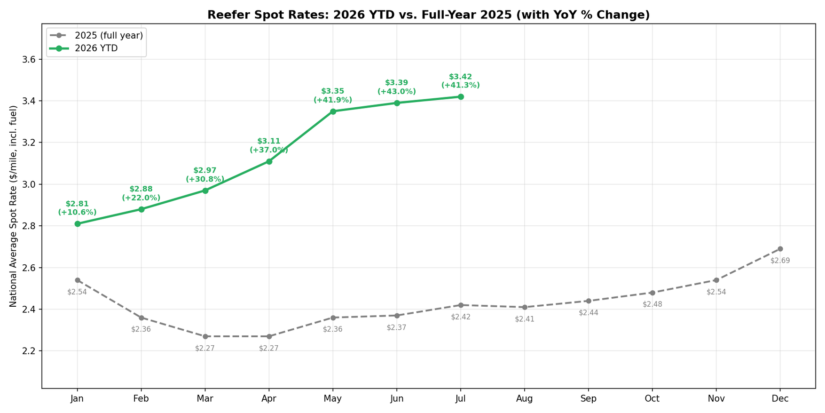
July was a genuine peak across all three major segments. Here’s how 2026 stacks up against 2025 so far.
Dry Van
Dry van spot rates are up 7.9% year-over-year in January, climbing to a peak of 48.5% in June and July.
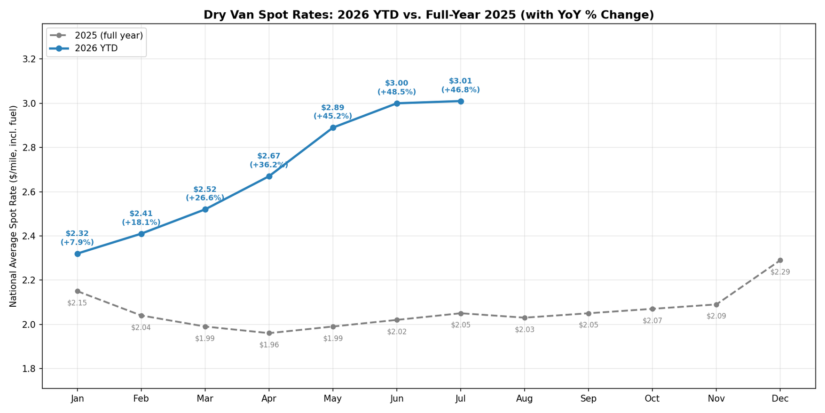
Demand for dry van has only grown about 1% this year. Almost the entire increase you’re seeing is coming from the supply side — fewer trucks, not more freight.
Reefer
Reefer followed a similar path, up 10.6% in January and peaking around 43% in June/July.
Flatbed’s Two-Pillar Tailwind: AI and Defense
Flatbed has been the standout performer of 2026 — up 16.8% in January and peaking at 43.6% in June.
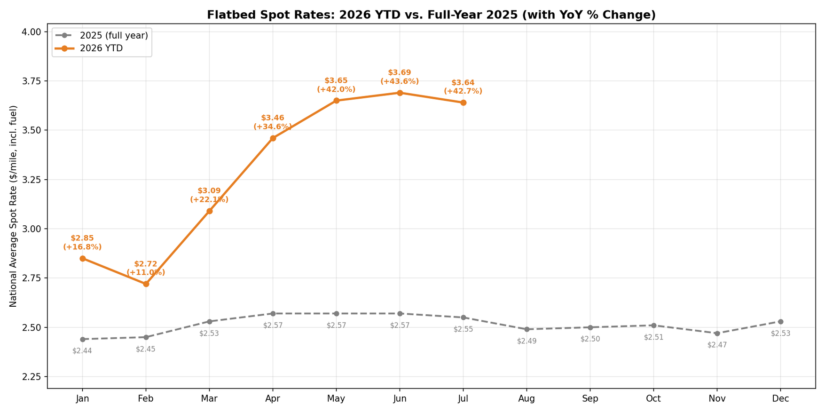
Unlike dry van and reefer, flatbed’s rate growth is mostly demand-driven, not regulation-driven. Residential housing is flat, so that’s not it. The real driver is a two-pillar structural tailwind:
- AI infrastructure. Every gigawatt of new data center capacity requires roughly 100,000 truckloads of concrete, steel, transformers, and generators. Flatbed posted a 24-week streak of consecutive rate increases from October 2025 through mid-June 2026.
- Defense production. A proposed $1.5 trillion defense bill for 2027 would move a large volume of munitions, machinery, and equipment — freight that moves almost exclusively on flatbed.
Add in non-residential construction (utility and energy infrastructure — solar, wind, hydrogen) and domestic steel capacity utilization running near 79% as of early August, and flatbed is positioned for a multi-year tailwind, not a one-quarter spike.
The August Reset: Cooling Off, Not Breaking Down
By the week of August 7, spot rates had posted their fourth or fifth straight weekly decline, down more than 17% off the July 4th peak. Linehaul rates (excluding fuel) were sitting around $2.32 for dry van, $2.65 for reefer, and $2.83 for flatbed. Tender rejections eased from 17.65% down to 13.6% — still well above the roughly 4.75% baseline that signals a balanced market.
Down from record highs is not the same as weak. This is a market resetting to a new, higher baseline — not a market breaking.
Manufacturing Is Confirming It: PMI and Tonnage Data
Two independent indicators back up what the rate data is showing:
- The ISM Manufacturing PMI hit 55.6% in July — the highest reading in four years. Anything above 50 means factories are growing; below 42.3 puts the whole economy at risk. We’re well clear of both lines, and purchasing managers are already flagging that inventory is running too low.
- The ATA Truck Tonnage Index came in at 114.3 in May — squarely in the healthy 112–118 range, up 5.1% versus a year ago and outperforming typical seasonal patterns.
PMI tends to lead freight demand by a few weeks to months. When factories order more, truckloads follow.
Peak Season Is Coming Right on Schedule
The summer cooldown lines up with a predictable seasonal pattern, not a warning sign:
- August: Back-to-school demand, already underway
- September–October: Retailers front-loading inventory ahead of peak
- November–December: Black Friday through the holiday stretch, the highest-intensity volume window of the year
The Real Driver: Truck Capacity Is Being Regulated Out
This isn’t just a tight market — it’s a market where truck capacity is being permanently removed.
Q1 2026 was genuinely net positive: more carriers entered than left, the best quarter since Q3 2022. But Q2 flipped: new authority applications surged as carriers chased high rates, while net revocations accelerated 31% year-over-year through the first half of 2026.
More are entering. More are being forced out. That’s not stabilization — that’s turnover, and the freight isn’t necessarily going to the newest truck on the road.
Three Enforcement Waves Hit at Once
Three separate enforcement actions landed on top of each other in Q2–Q3 2026:
- Non-domiciled CDL rule (March). Cut renewal eligibility for roughly 97% of the estimated 200,000 non-domiciled CDL holders.
- ELD crackdown. 60 devices revoked year-to-date through early August — a steady drumbeat nearly every month.
- Montgomery v. Caribe Transport (SCOTUS, May). Brokers can now be sued directly for hiring unsafe carriers — part of why C.H. Robinson took a $600 million-plus verdict in July.
Alongside those three, roughly 6,800 CDL training locations were shut down in 2026 — the largest sustained enforcement action against CDL schools in FMCSA history.
The Vetting Bar Has Never Been Higher
Brokers are now auditing new-hire drivers against the training registry before tendering freight, because a bad carrier hire can now expose them to state-court liability — not just a bad load.
If you’re a new authority, or a small fleet without a clean safety record, you’re now competing for freight in a market where getting booked has become just as hard as finding the load in the first place.
Cargo theft adds another layer of risk. Incidents were down 26% year-over-year in Q2 2026, but losses jumped to $304.6 million, up 125%. Criminals are getting pickier, targeting high-value metals and tech, and increasingly working the digital side — rerouting shipments through compromised email rather than physically hitting a truck.
What Carriers Are Actually Feeling Right Now
Individual experience varies a lot by lane, equipment type, and broker relationships, but a few numbers stand out:
- 97% of account managers say cash flow is still carriers’ number one financial issue
- 26% of fleets report cautious optimism, versus 53% who report concern or mixed feelings
- The FTR Trucking Conditions Index hit 20.4 in May — the strongest reading since before the pandemic-era boom, driven almost entirely by favorable rates
The squeeze is concentrated in smaller fleets. Net revocations are down versus 2025, but small operators are still getting hit by fuel and insurance spikes even as larger fleets post double-digit gains. Bankruptcies haven’t stopped either — more than 20 trucking-related filings occurred in a recent 30-day window.
Reducing speed from 75 → 65 mph:
Equivalent to +8 cents per mile
Spot or Contract? What Small Carriers Should Do Right Now
The carriers who make it through the next six months aren’t the ones who catch the best rate. They’re the ones who fix their cash flow discipline before peak season hits — because the freight is coming, but so are 90-day payment terms, insurance renewals, and a broker checking your safety score twice.
Three concrete things to track between now and Q4:
1. Tender rejection rates into September and October
A climb back up as peak-season front-loading begins would confirm real demand-driven tightening — not just regulatory noise.
2. Your safety score and training documentation
In this environment, that’s a commercial asset, not just a compliance checkbox. Brokers are checking it before they tender you a load.
3. Your cash flow runway — before peak season, not during it
Build the reserve now, while rates are still historically elevated. Net-60 and Net-90 payment terms are becoming more common than Net-30.
Action Checklist for Carriers
- Decide your spot vs. contract mix based on your lanes and risk tolerance
- Audit your safety score and training documentation before peak season
- Calculate your true weekly breakeven (fixed + variable costs)
- Build a cash reserve now, ahead of stretching payment terms
- Track tender rejection rates into September and October
- Watch your ELD compliance status — 60 days to replace a revoked device
The trucks that left the market this year aren’t coming back — not because the freight disappeared, but because the bar to stay in this business got permanently higher. The carriers who treat that as a real shift, not a temporary rough patch, are the ones who’ll still be running when peak season hits in October.
We broke this down in detail in our live market update webinar with Andrew Bazan, Director of Product & Marketing at Simplex Group.
Watch the webinar recap here: The Trucks Aren’t Coming Back: Full Webinar
Explore the full FAQ guide here: Trucking Capacity Shortage 2026 | Complete Q&A
If your operation isn’t fully compliant, this market can hurt you more than help you.